
About This Worksheet
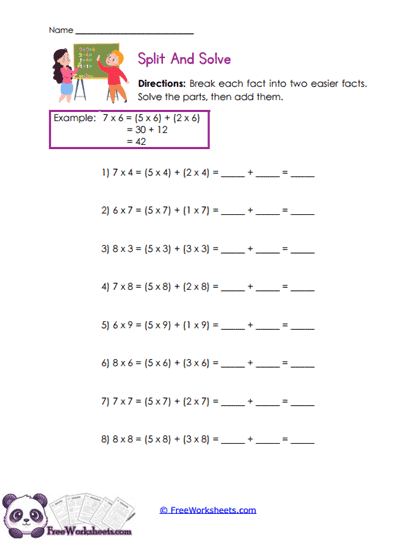
Product Breakdowns is a third grade multiplication-strategy activity that helps students split a harder fact into two easier multiplication facts. Each problem already shows how the first factor can be broken apart, and students solve the two smaller products before adding them together. For example, 7 × 6 is rewritten as (5 × 6) + (2 × 6), so students find 30 + 12 = 42. This gives children a practical way to solve unfamiliar facts using combinations they already know. The strategy also introduces the thinking behind the Distributive Property.
Curriculum and Grade Alignment
This worksheet is made for third grade learners who are ready to decompose multiplication facts into easier parts. The main goal is to help students use known facts such as ×5, ×2, or ×3 to build larger products. Before using this page, your child should understand basic multiplication facts and be comfortable adding two partial products. The next step is choosing their own useful breakdowns instead of having them provided. This activity supports multiplication strategies, decomposition, the Distributive Property, and mental math.
Student Tasks
Students will solve eight decomposed multiplication problems. Each fact is rewritten as two smaller multiplication facts, such as 7 × 4 = (5 × 4) + (2 × 4) or 8 × 6 = (5 × 6) + (3 × 6). Students solve each smaller fact, add the two partial products, and record the final total. The problems include factors such as 6, 7, 8, and 9. This builds flexible fact solving and understanding of how larger products can be constructed.
Common Challenges and Misconceptions
Some students may solve only one of the smaller facts and forget to add the second product. Others may add the factors instead of the products. A child may also think splitting the first factor changes the original answer. Encourage your child to check that the two smaller factors still add back to the original first factor. Then solve each multiplication part and combine the results.
Implementation Guidance
Teachers can use this worksheet after students have practiced arrays, partial products, or basic multiplication strategies. It works well as an introduction to the Distributive Property before formal property vocabulary is emphasized. Parents can draw an array and split it into two sections to show how the smaller facts still make the same whole. Ask the child to explain why the partial products must be added. This makes the strategy visual and meaningful.
Details and Features
This worksheet includes one worked example and eight multiplication problems in a single-column format. Each problem is already decomposed into two easier facts with spaces for both partial products and the final sum. The purple example box clearly models the process before students begin. The printable supports multiplication decomposition, partial products, the Distributive Property, and strategic fact fluency.