
About This Worksheet
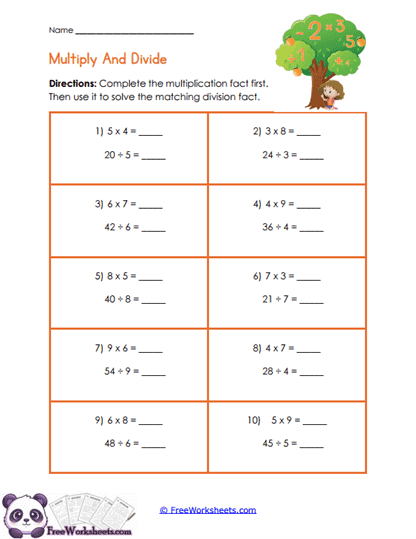
Fact Connection is a third grade multiplication-and-division activity that helps students use a known multiplication fact to solve a related division fact. Each problem first asks students to complete a multiplication equation and then immediately use that product to find the quotient in a matching division equation. For example, 5 × 4 = 20 helps students solve 20 ÷ 5 = 4. This helps children see that multiplication and division are inverse operations that belong to the same fact family. The paired format makes the relationship especially clear.
Curriculum and Grade Alignment
This worksheet is made for third grade learners who are strengthening basic division fact fluency through multiplication connections. The main goal is to help students use multiplication facts they already know to solve division efficiently. Before using this page, your child should have some familiarity with multiplication facts through 9 and understand the idea of related facts. The next step is solving division facts independently and using multiplication only as a mental check. This activity supports inverse operations, fact-family reasoning, and quotient fluency.
Student Tasks
Students will complete ten paired multiplication and division problems. They first solve facts such as 5 × 4, 3 × 8, 6 × 7, and 4 × 9, then use the product to solve a related division fact such as 20 ÷ 5 or 24 ÷ 3. The factors range across common third grade fact families. Because each pair is directly related, students can see how the quotient comes from the missing factor in the multiplication equation. This builds efficient division strategies and fact recall.
Common Challenges and Misconceptions
Some students may solve the multiplication fact correctly but not recognize which factor becomes the quotient. Others may confuse the divisor with the product or try to create an unrelated division fact. A child may also rely on repeated subtraction even when the multiplication fact is already known. Encourage your child to read the pair as one family: “If 5 times 4 is 20, then 20 divided by 5 is 4.” This makes the inverse relationship easier to remember.
Implementation Guidance
Teachers can use this worksheet after multiplication facts are reasonably familiar and division is being introduced or reviewed. It works well as a bridge from multiplication fluency to division fluency. Parents can have the child cover the division line, solve the multiplication fact, and then predict the related quotient before uncovering it. Fact-family triangles or flash cards can also reinforce the same relationship. This helps division feel less like a brand-new skill.
Details and Features
This worksheet includes ten orange-bordered multiplication-division pairs. Each problem contains one multiplication fact followed by a directly related division fact. The facts use products up to 72 and emphasize common third grade combinations. The printable supports multiplication fluency, division fluency, inverse operations, and fact-family understanding.