
About This Worksheet
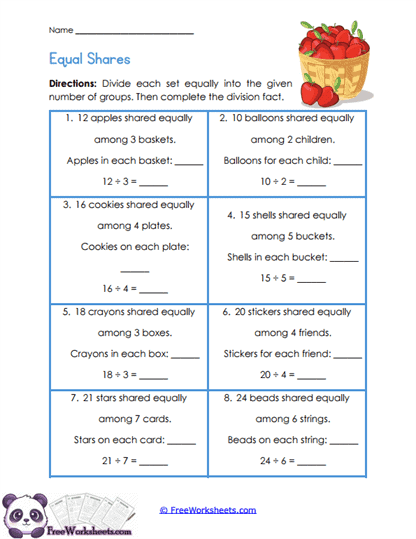
Equal Share Stories is a third grade division activity that helps students understand division as sharing a total equally among a known number of groups. Each problem gives a collection of familiar objects, such as apples, balloons, cookies, shells, crayons, stickers, stars, or beads, and tells students how many baskets, children, plates, boxes, or other groups should receive equal shares. Students find how many objects belong in each group and then complete the matching division fact. For example, 12 apples shared equally among 3 baskets means 12 ÷ 3 = 4. This helps children connect everyday sharing situations with division equations.
Curriculum and Grade Alignment
This worksheet is made for third grade learners who are beginning or reviewing basic division concepts. The main goal is to help students understand division as equal sharing and connect the story situation to a symbolic equation. Before using this page, your child should be comfortable counting equal groups and have some familiarity with multiplication facts. The next step is solving similar division problems without a story or using multiplication to check each quotient. This activity supports equal-sharing reasoning, quotient fluency, and multiplication-division connections.
Student Tasks
Students will solve eight equal-sharing problems. They determine how many apples go in each basket, balloons go to each child, cookies go on each plate, shells go in each bucket, and so on. After finding the equal share, they complete the division equation shown beneath each story. The numbers include totals such as 12, 10, 16, 15, 18, 20, 21, and 24. This builds division understanding and fact fluency with manageable third grade numbers.
Common Challenges and Misconceptions
Some students may confuse the number of groups with the number in each group. Others may multiply instead of divide because the problem contains familiar multiplication-fact numbers. A child may also split the objects unevenly and still try to write a quotient. Encourage your child to identify the total first, then the number of groups, and ask, “How many go in each group?” This keeps the meaning of division clear.
Implementation Guidance
Teachers can use this worksheet when introducing division through equal sharing or as review after using manipulatives. It works well in small groups because students can act out a few problems with counters before writing the division fact. Parents can use small objects such as coins or blocks to physically share the total into equal groups. After sharing, have the child count one group and write the equation. This keeps the abstract notation connected to the concrete idea.
Details and Features
This worksheet includes eight equal-sharing word problems in a blue two-column grid. Each problem gives a total, a number of equal groups, a space for the amount in each group, and a division equation. The familiar objects make the sharing situations easy to picture. The printable supports division concepts, equal groups, quotient fluency, and story-to-equation connections.