
About This Worksheet
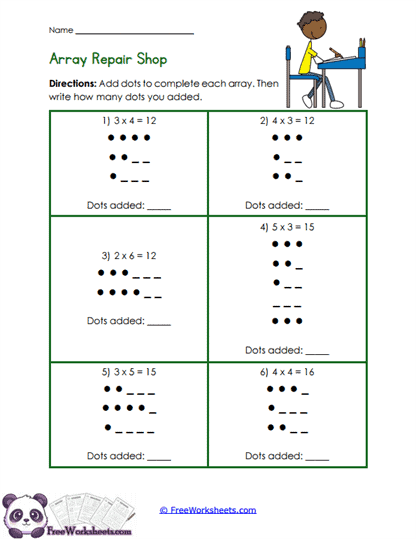
Array Repair is a third grade multiplication activity that asks students to complete unfinished arrays by adding the missing dots. Each problem shows a multiplication equation along with a partly built array. Students figure out how many dots are still needed so the model matches the equation. For example, if the equation is 3 × 4 = 12 and only part of the 3-by-4 array is shown, students add the missing dots to complete all 12 objects. This helps children connect the factors, the total product, and the visual structure of an array.
Curriculum and Grade Alignment
This worksheet is made for third grade learners who understand basic arrays and are ready to work with incomplete models. The main goal is to help students use multiplication facts to determine what is missing from a visual representation. Before using this page, your child should be able to count rows and objects in each row and write a matching multiplication equation. The next step is using arrays to solve missing-factor problems or explain how a known product can be built in different ways. This activity supports multiplication fluency, visual reasoning, and missing-part thinking.
Student Tasks
Students will complete six partially drawn arrays. Each box gives a multiplication equation such as 3 × 4 = 12, 4 × 3 = 12, 2 × 6 = 12, 5 × 3 = 15, 3 × 5 = 15, or 4 × 4 = 16. Students add the missing dots so each array has the correct number of rows and objects in each row. They then record how many dots they added. This builds multiplication fact knowledge, counting accuracy, and understanding of how arrays are structured.
Common Challenges and Misconceptions
Some students may count only the dots already shown and forget that the equation gives the total the array should have. Others may add the correct number of dots but place them in the wrong rows, creating uneven groups. A child may also focus on the product without checking whether the row arrangement matches the two factors. Encourage your child to identify the intended number of rows and objects per row first. Then compare that full array with what is already drawn.
Implementation Guidance
Teachers can use this worksheet after students have practiced creating arrays from scratch. It works well as a next step because the student must analyze what is present and what is missing. Parents can ask the child to lightly sketch the full rectangle around the array before filling the gaps. Then count how many spaces still need dots. This keeps the visual structure clear and prevents random placement.
Details and Features
This worksheet includes six green-bordered incomplete-array problems. Each problem shows a multiplication equation, a partial dot model, and a line for recording how many dots were added. The models use products through 16 and include several different row arrangements. The printable supports multiplication facts, array completion, missing-part reasoning, and visual organization.