
About This Worksheet
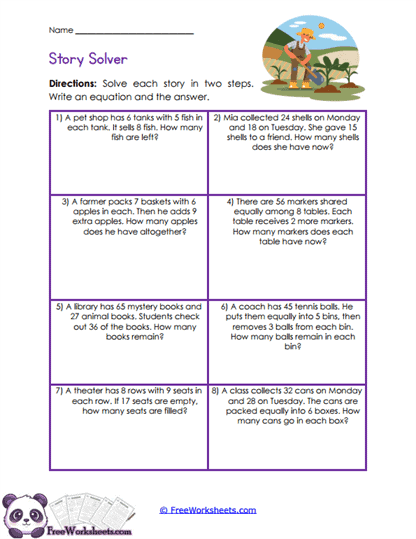
Two-Step Tales is a third grade problem-solving activity that asks students to solve each story in two steps. The problems involve addition, subtraction, multiplication, and division in situations such as pet shops, shell collections, farm baskets, markers, library books, tennis balls, theater seating, and canned goods. Students must decide which operation comes first, solve that part, and then use the result in the second step. For example, a problem may require combining two amounts and then sharing the total equally. This helps children organize their thinking and see how one answer can become the starting point for the next calculation.
Curriculum and Grade Alignment
This worksheet is intended for third grade learners who are ready to move beyond one-step word problems. The main goal is to help students plan and solve two-step situations using the four basic operations. Before beginning, your child should be comfortable with one-step addition, subtraction, multiplication, and division stories. The next step is solving multi-step problems with extra information or more complex reasoning. This activity supports problem solving, operation choice, sequencing, and mathematical communication.
Student Tasks
Students will solve eight two-step word problems. They work with fish tanks, seashells, apples, markers, library books, tennis balls, theater rows, and cans. Each story requires two calculations, such as multiplying and then adding, adding and then subtracting, or dividing and then subtracting. Students write an equation and the final answer. This builds planning, computation, and multi-step reasoning.
Common Challenges and Misconceptions
Some students may try to use both numbers in one operation and stop after the first step. Others may choose the correct operations but use them in the wrong order. A child may also forget to carry the first answer into the second step. Encourage your child to ask, “What do I need to know first?” and then, “What do I do with that answer?” This gives a clear structure for solving.
Implementation Guidance
Teachers can use this worksheet after students are confident with one-step word problems. It works well in small groups because students can explain why one operation must come before another. Parents can have the child underline the information for step one and circle the information needed for step two. If a story feels complicated, draw a quick bar model or write two separate equations. This makes the sequence easier to follow.
Details and Features
This worksheet includes eight two-step word problems in a purple two-column grid. The stories use addition, subtraction, multiplication, and division in different combinations. Each large box provides space for students to show both steps. The printable supports multi-step reasoning, operation selection, computation, and word-problem comprehension.