
About This Worksheet
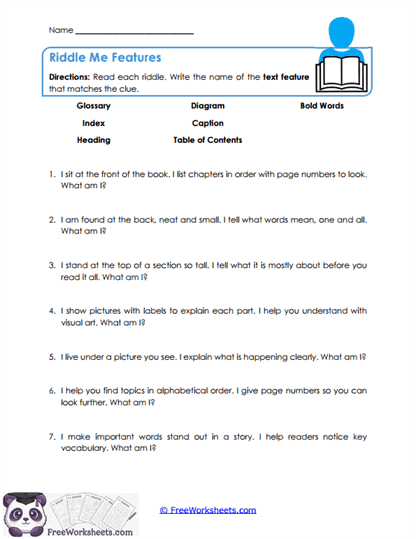
This worksheet focuses on identifying text features through clues and descriptions. Text features are important tools that help readers understand, organize, and locate information in nonfiction texts. Third-grade students strengthen their understanding when they recognize text features based on what they do rather than simply what they are called. For example, a clue about defining unfamiliar words points to a glossary. This activity encourages critical thinking and reinforces nonfiction reading skills in a fun and engaging way.
Curriculum and Grade Alignment
This worksheet is intended for Grade 3 students studying informational text features and reading comprehension. The primary learning goal is identifying text features based on their purposes and functions. Students should already have experience working with glossaries, indexes, headings, captions, and tables of contents. The next progression involves using these features independently while reading and researching. This activity aligns with CCSS RI.3.5 and supports TEKS 3.9F through the interpretation of nonfiction text features.
Student Tasks
On this worksheet, students will read a series of riddles that describe different text features. Learners must determine which feature matches each clue and write the correct answer. Students use their understanding of feature purposes to solve the riddles. The activity combines reading comprehension, vocabulary development, and critical thinking. It provides an engaging review of nonfiction reading tools.
Common Challenges and Misconceptions
Many students remember the names of text features but struggle to identify them through descriptions. Some learners confuse similar features because they all help readers in different ways. Others focus on one word in the clue rather than considering the entire description. Readers sometimes rush through the riddles without thinking about the purpose being described. Teachers should encourage students to focus on what each feature helps a reader do.
Implementation Guidance
Teachers can use this worksheet as a review activity at the end of a text features unit. It works well as a literacy center, partner activity, or independent challenge. Parents may turn the riddles into a game and discuss why each answer is correct. Homeschool educators can extend learning by having students write their own text feature riddles. The worksheet makes review fun while reinforcing important nonfiction reading skills.
Details and Features
The worksheet includes a collection of age-appropriate riddles covering several major text features. Students practice identifying features based on function rather than memorization. The format encourages reasoning, inference, and application of knowledge. The printable design supports classroom instruction, homework assignments, literacy centers, and homeschool learning. Its puzzle-like structure helps students stay engaged while reviewing nonfiction concepts.