
About This Worksheet
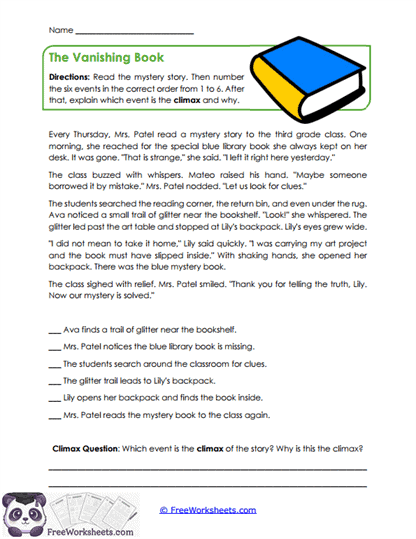
This worksheet focuses on sequencing events and identifying the climax of a story. Sequencing is the ability to place events in the order they happen, while the climax is the most exciting or important turning point in a narrative. Third-grade students strengthen comprehension when they learn how story events build toward a key moment. For example, following clues in a mystery story can lead to the discovery that solves the problem. This activity helps readers understand plot structure and narrative progression.
Curriculum and Grade Alignment
This worksheet is designed for Grade 3 students studying plot development and story structure. The primary learning goal is identifying chronological events and recognizing the climax of a story. Students should already be able to identify beginning, middle, and end events in a narrative. The next progression involves analyzing how the climax affects the resolution and overall story meaning. This activity aligns with CCSS RL.3.3 and supports TEKS 3.8A through analysis of plot elements.
Student Tasks
On this worksheet, students will read a mystery story about a missing library book. They will place important events in the correct order from first to last. Learners must identify the climax and explain why it is the most important moment in the story. Students use evidence from the passage to support their decisions. The activity encourages careful reading and understanding of narrative structure.
Common Challenges and Misconceptions
Many students confuse the climax with the ending of the story. Some learners remember events but struggle to place them in the correct sequence. Others may choose an exciting moment that is not actually the turning point of the plot. Readers sometimes focus on minor details rather than major story events. Teachers should encourage students to ask which event changes the direction of the story most significantly.
Implementation Guidance
Teachers can use this worksheet during lessons on plot structure and literary analysis. It works well as guided practice before students identify climaxes in longer stories. Parents may discuss how the mystery unfolds and what event finally solves the problem. Homeschool educators can extend learning by comparing the climax of this story to another mystery text. The worksheet promotes strong comprehension and sequencing skills.
Details and Features
The worksheet includes an engaging mystery narrative with a clear sequence of events. Students complete both a sequencing activity and a climax analysis task. The structured format guides learners through important plot elements. The printable design supports classroom instruction, homework assignments, literacy centers, and homeschool learning. Its mystery theme helps keep students engaged while practicing reading skills.