
About This Worksheet
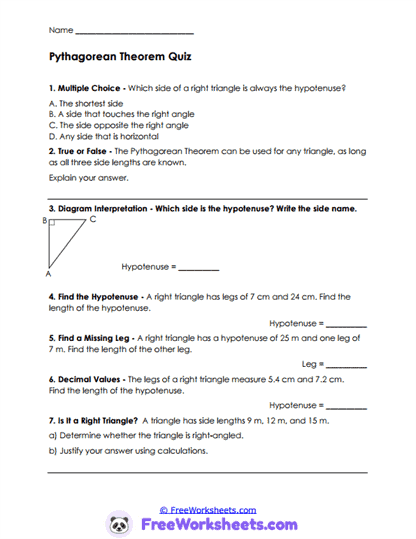
The Pythagorean Theorem explains the relationship between the sides of a right triangle. This worksheet reviews important theorem concepts through multiple-choice questions, diagrams, and calculation problems. Students identify hypotenuses, solve for missing side lengths, and determine whether triangles are right-angled. For example, a triangle with side lengths 9, 12, and 15 satisfies the theorem because the equation balances correctly. The activity combines vocabulary, calculations, and reasoning into one review page.
Curriculum and Grade Alignment
This worksheet supports geometry standards involving right triangles, square roots, and geometric reasoning. The main learning goal is to review and apply the Pythagorean Theorem across different problem types. Students should already understand basic theorem setup and square number operations before beginning. The next learning step is applying these ideas to coordinate geometry and more advanced proofs. This aligns with HSG-SRT.C.8 because students solve and analyze right triangle relationships.
Student Tasks
On this worksheet, students will answer questions about hypotenuses, missing side lengths, and theorem applications. They will solve right triangle equations and justify whether certain triangles are right-angled. Students also interpret diagrams and explain their reasoning using calculations. Several problems require learners to show supporting work beside their answers.
Common Challenges and Misconceptions
Some students may confuse the hypotenuse with one of the legs of the triangle. Others may forget to square values before adding or subtracting them in the equation. A common mistake is assuming a triangle is right-angled without checking the theorem carefully. Teachers can help by encouraging students to organize side lengths from shortest to longest before solving.
Implementation Guidance
This worksheet works well as a quiz review, independent assessment practice, or end-of-unit reinforcement activity. Teachers can use the mixed question types to check both procedural skills and conceptual understanding. Parents helping at home can ask students to explain why each triangle does or does not satisfy the theorem. Those conversations often help students think more carefully about the relationships between the sides.
Details and Features
The worksheet includes multiple-choice questions, labeled triangle diagrams, and open-response calculation problems. Students practice identifying, solving, and explaining theorem relationships in one activity. The printable layout provides room for showing work and writing short explanations. The review format makes the worksheet useful for classroom review, homework, or test preparation.