
About This Worksheet
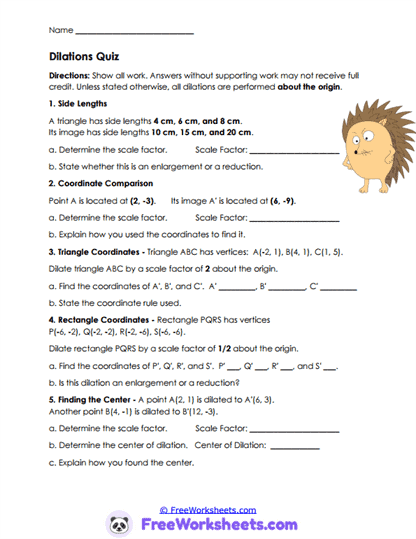
A dilation changes the size of a figure by using a scale factor while keeping the figure similar to the original. This worksheet reviews coordinate dilations, scale factors, and image measurements through a mix of geometry problems. Students compare figures, find missing coordinates, and determine whether figures were enlarged or reduced. For example, a triangle with points near the origin may double in size after a dilation with a scale factor of 2. The activity combines graphing, ratios, and geometric reasoning into one review page.
Curriculum and Grade Alignment
This worksheet supports transformation geometry and similarity concepts. The main learning goal is to strengthen understanding of dilations and proportional relationships between figures. Students should already know how to graph coordinates and compare side lengths before completing this review. The next step is applying these concepts to proofs involving similar figures and transformations. This aligns with HSG-SRT.A.1 and HSG-SRT.A.2 because students analyze dilations and proportional relationships.
Student Tasks
On this worksheet, students will solve coordinate dilation problems and compare original figures with image figures. They will determine scale factors and calculate missing side lengths or coordinates. Students also decide whether each example represents an enlargement or a reduction. Several questions ask learners to explain how they found their answers using ratios or graph observations.
Common Challenges and Misconceptions
Some students may forget that every coordinate must change by the same scale factor during a dilation. Others may reverse the ratio when solving for missing measurements. A common mistake is mixing up original figures with image figures when comparing lengths or coordinates. Teachers can help by encouraging students to label each figure clearly before starting calculations.
Implementation Guidance
This worksheet is useful as a review activity before an assessment or at the end of a transformation unit. Teachers can assign sections separately for warm-up work, partner review, or independent practice. Parents helping at home can ask students to explain how they know whether a figure became larger or smaller. These short explanations help students focus on understanding instead of memorizing steps.
Details and Features
The worksheet includes coordinate problems, scale factor calculations, and visual geometry comparisons. Students practice multiple dilation skills within the same activity for stronger review. The printable layout provides space for calculations, graph work, and written explanations. Mixed problem types help students build confidence applying the same concept in different ways.