
About This Worksheet
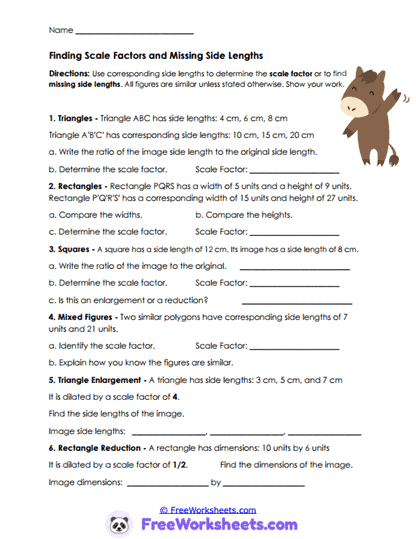
A scale factor compares the size of an image to the size of its original figure. This worksheet helps students use side lengths to determine scale factors and solve missing measurements. Students compare triangles, rectangles, and squares to understand how similar figures keep the same shape while changing size. For example, a side length of 4 may become 10 when enlarged by a scale factor of 2.5. The activity combines geometry, multiplication, and ratio reasoning in one lesson.
Curriculum and Grade Alignment
This worksheet supports similarity and proportional reasoning standards in geometry. The main learning goal is to compare corresponding side lengths and use ratios to solve for unknown values. Students should already understand multiplication, division, and basic ratio concepts before starting this page. The next step is applying these ideas to similarity proofs and geometric problem solving. This aligns with HSG-SRT.A.2 because students study proportional relationships created by dilations.
Student Tasks
On this worksheet, students will compare side lengths from original figures and image figures. They will calculate scale factors and solve for missing dimensions using ratios. Students also decide whether each situation shows an enlargement or a reduction. Several problems ask learners to explain how they know two figures are similar.
Common Challenges and Misconceptions
Some students may compare the side lengths in the wrong order and end up with an incorrect scale factor. Others may forget that corresponding sides must match correctly before solving. A common mistake is treating every ratio greater than 1 as a reduction instead of an enlargement. Teachers can help by having students label original and image measurements before writing ratios.
Implementation Guidance
This worksheet works well for guided practice, partner activities, or review before an assessment. Teachers can encourage students to check whether the figure became larger or smaller before calculating the ratio. Parents helping at home can ask students to explain why the figures are still the same shape even after resizing. These conversations help students build confidence with similarity concepts.
Details and Features
The worksheet includes a variety of geometric figures with labeled side lengths and open workspaces for calculations. Students practice finding both missing side lengths and unknown scale factors. The printable format is easy to use in class, during tutoring sessions, or for independent review. The progression of questions moves from straightforward comparisons to more detailed reasoning tasks.