
About This Worksheet
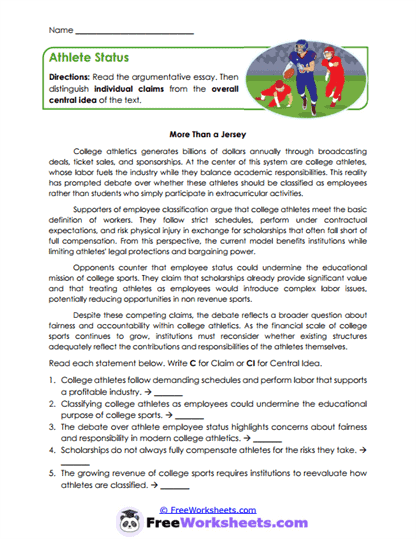
This worksheet helps students understand the difference between individual claims and the overall central idea in an argumentative text. A claim is one point the author makes, while the central idea is the main message that ties everything together. The passage focuses on whether college athletes should be treated as employees. For example, one claim might say athletes deserve pay, while another discusses fairness, but the central idea brings those ideas together into one main argument. This helps students organize complex information more clearly.
Curriculum and Grade Alignment
This worksheet is designed for 12th grade students who are developing strong argument analysis skills. The main goal is to distinguish between smaller supporting ideas and the overall central idea. Before this, students should understand main idea basics, and now they are learning how arguments are built. The next step is evaluating arguments and writing their own. It aligns with CCSS.ELA-LITERACY.RI.11-12.2 and RI.11-12.8. It also supports TEKS standards related to analyzing persuasive texts.
Student Tasks
On this worksheet, students will read an argumentative passage about college athletics. They will review several statements and decide whether each one is a claim or the central idea. Students must think carefully about how each statement fits into the overall argument. This helps them understand how authors build their ideas step by step. It encourages careful reading and thoughtful decision-making.
Common Challenges and Misconceptions
Students often confuse a strong claim with the central idea. Some may choose answers based on how important a statement sounds instead of how it functions in the text. Others might not fully understand how multiple claims support one main idea. It is also common to rush through the task without thinking deeply. A helpful approach is to ask, “Does this support the argument, or is it the argument?”
Implementation Guidance
Teachers can use this worksheet during lessons on argument structure and analysis. It works well as practice before students write their own essays. At home, parents can help by talking through each statement and asking why it fits a certain category. This builds understanding step by step. Even simple discussions can make a big difference in comprehension.
Details and Features
This worksheet includes a focused argumentative passage and sorting tasks. It is designed to build understanding of how arguments are structured. The format is clear and easy to follow. It supports both independent work and discussion. The topic is relevant and engaging for students.