
About This Worksheet
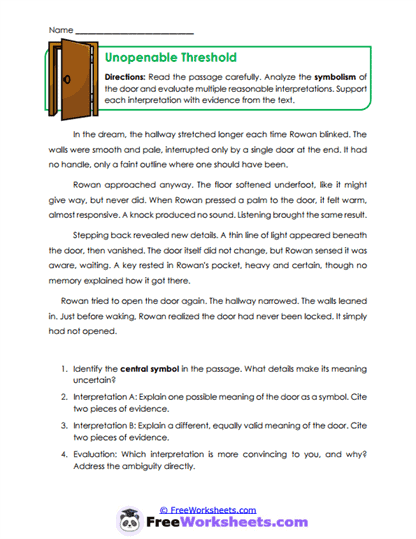
This worksheet helps students explore symbolism in a more complex and open-ended way. It focuses on how one object-in this case, a door-can represent different ideas depending on how it is interpreted. Your child will learn that literature does not always have just one clear meaning. For example, a locked door might represent fear, missed opportunity, or uncertainty about the future. This helps students become more flexible and thoughtful in their reading.
Curriculum and Grade Alignment
This worksheet is designed for 12th grade students working on higher-level interpretation skills. The main goal is to analyze symbolism and consider multiple possible meanings. Before this, students should be comfortable identifying symbols, and now they are learning to explore different interpretations. The next step is defending their ideas with strong evidence. It aligns with CCSS.ELA-LITERACY.RL.11-12.2 and RL.11-12.4. It also supports TEKS standards for literary interpretation and analysis.
Student Tasks
On this worksheet, students will read a passage centered around a mysterious door. They will identify the central symbol and explain what it might represent. Students are asked to come up with more than one possible interpretation. They must support each idea with evidence from the text. Finally, they choose the interpretation they think is strongest and explain why.
Common Challenges and Misconceptions
Students may think there is only one correct answer and feel unsure when asked for multiple interpretations. Some might give ideas without strong evidence to support them. Others may struggle to explain why one interpretation is stronger than another. It is also common to stay at a surface level instead of thinking more deeply. A helpful strategy is to remind students that good answers are supported, not just correct.
Implementation Guidance
Teachers can use this worksheet during lessons on symbolism or theme. It works well for class discussions where students can compare different interpretations. At home, parents can support by encouraging their child to explain their thinking step by step. This builds confidence in handling more complex ideas. Even simple questions like “What else could this mean?” can help students go deeper.
Details and Features
This worksheet includes a thought-provoking passage and structured questions. It is designed to encourage deeper thinking and multiple perspectives. The format is clear and easy to use. It supports written responses and discussion. The content challenges students in a meaningful way.