
About This Worksheet
This worksheet helps your student look deeper into a story to understand what a character is really feeling, even when it is not directly said. It focuses on literary devices like symbolism, metaphor, and irony, which are tools authors use to add hidden meaning. Your child will learn how objects, actions, and situations can stand for bigger ideas. For example, something simple like a jacket might represent comfort, guilt, or a difficult choice depending on how it is used in the story. This helps students move beyond just reading words and start understanding meaning at a deeper level.
Curriculum and Grade Alignment
This worksheet is designed for 12th grade students who are learning advanced reading and analysis skills. The main goal is to help them recognize and explain how literary devices reveal a character’s inner conflict. Before this, students should already know basic story elements, and now they are learning how authors build deeper meaning through language. The next step is using these ideas in writing and literary essays. It aligns with CCSS.ELA-LITERACY.RL.11-12.4, which focuses on analyzing word choice and meaning. It also connects to TEKS standards that involve analyzing literary techniques.
Student Tasks
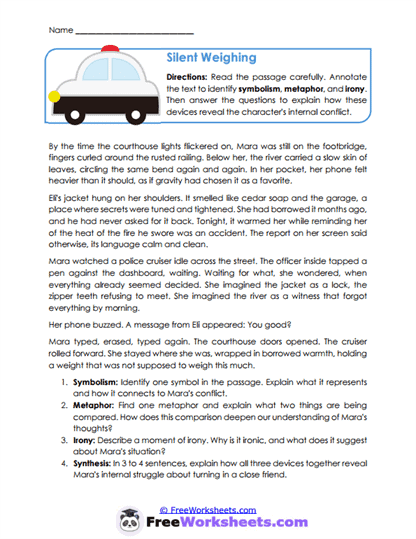
On this worksheet, students will read a short passage about a character dealing with a difficult situation. They will identify examples of symbolism, metaphor, and irony within the text. Students must explain what each example means and how it connects to the character’s emotions. They will also bring these ideas together in a final response that explains the character’s internal struggle. This pushes students to think carefully and explain their ideas clearly.
Common Challenges and Misconceptions
Students often find it easier to point out a literary device than to explain what it means. Some may think a symbol has only one meaning, when it can actually have several layers. Others might confuse metaphor with simple description. It is also common for students to miss the irony if they are not paying close attention to expectations versus reality. A helpful way to support them is to ask, “What does this detail stand for beyond what it is?”
Implementation Guidance
Teachers can use this worksheet during a unit on literary analysis or author’s craft. It works well as guided practice before asking students to write essays. At home, parents can help by asking their child to explain their answers out loud. This turns the activity into a conversation and helps build confidence. Even focusing on one question at a time can make the task feel more manageable.
Details and Features
This worksheet includes a rich passage and several focused questions on literary devices. It encourages written explanations rather than simple answers. The layout is clean and easy to follow. It supports both classroom instruction and independent practice. The final synthesis question helps students bring all their thinking together.