
About This Worksheet
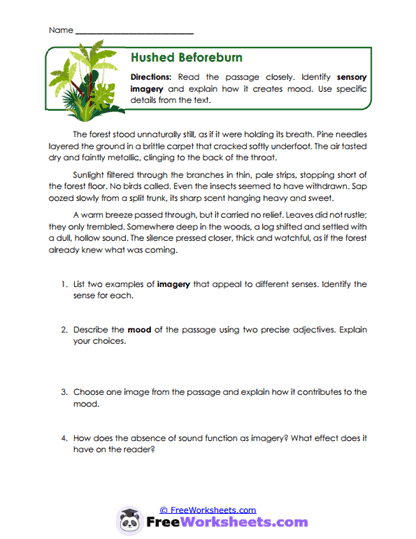
This worksheet helps students understand how authors use sensory imagery to create a strong feeling or mood in a passage. Sensory imagery means details that appeal to the senses, like sight, sound, smell, touch, and taste. Your child will learn how these details help the reader “feel” what is happening instead of just reading about it. For example, describing dry needles cracking underfoot helps the reader hear and feel the environment. This kind of reading helps students become more connected to what they are reading.
Curriculum and Grade Alignment
This worksheet is designed for 12th grade students who are working on deeper literary analysis. The main goal is to help them identify imagery and explain how it shapes mood. Before this, students should recognize descriptive details, and now they are learning how those details affect meaning. The next step is analyzing how imagery connects to theme and tone. It aligns with CCSS.ELA-LITERACY.RL.11-12.4, focusing on word choice and meaning. It also supports TEKS standards for analyzing literary techniques.
Student Tasks
On this worksheet, students will read a descriptive passage about a forest environment. They will identify examples of imagery that appeal to different senses. Students must explain how those details create a certain mood in the passage. Some questions ask them to focus on specific images and explain their impact. This helps students slow down and really think about how language works.
Common Challenges and Misconceptions
Students may find it easy to spot descriptive words but harder to explain their effect. Some might list examples without connecting them to mood. Others may focus only on one sense instead of seeing how multiple senses work together. It is also common to give very general answers like “it sounds scary” without explaining why. A helpful strategy is to ask, “What do you picture, hear, or feel when you read this?”
Implementation Guidance
Teachers can use this worksheet during lessons on descriptive writing or literary analysis. It works well as practice before students write their own descriptive passages. At home, parents can help by asking their child to describe what they imagine while reading. This makes the activity more interactive and meaningful. Even reading the passage out loud can help bring the imagery to life.
Details and Features
This worksheet includes a vivid passage and focused questions about imagery and mood. It encourages students to explain their thinking clearly. The format is clean and easy to print. It supports both individual work and group discussion. The content is engaging and builds strong reading skills.