
About This Worksheet
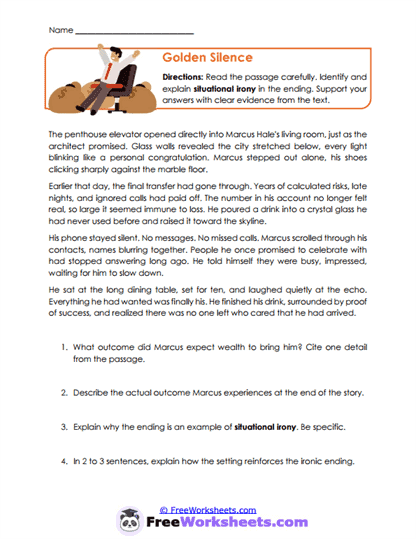
This worksheet helps students understand situational irony, which happens when the outcome is different from what we expect. It uses a story about success and wealth to show how life does not always turn out the way people imagine. Your child will learn how authors create meaning by surprising the reader. For example, a character may gain everything they wanted but still feel empty or alone. This helps students think more deeply about outcomes and expectations.
Curriculum and Grade Alignment
This worksheet is designed for 12th grade students who are working on advanced literary understanding. The main goal is to recognize and explain situational irony in a story. Before this, students should understand basic plot and conflict, and now they are learning how outcomes shape meaning. The next step is analyzing how irony connects to theme. It aligns with CCSS.ELA-LITERACY.RL.11-12.3 and RL.11-12.4. It also supports TEKS standards for analyzing literary devices.
Student Tasks
On this worksheet, students will read a passage about a successful character and their life. They will identify what the character expected to happen and what actually happened instead. Students will explain why this difference creates irony. Some questions ask them to connect the setting to the story’s meaning. This helps them see how different parts of a story work together.
Common Challenges and Misconceptions
Students often confuse irony with something simply being surprising or unfortunate. Some may struggle to clearly explain the difference between expectation and reality. Others might give answers that are too general without using details from the text. It is also common to miss how the setting adds to the irony. A helpful tip is to ask, “What did the character think would happen, and what really happened instead?”
Implementation Guidance
Teachers can use this worksheet during lessons on irony or theme. It works well as a discussion activity where students compare ideas. At home, parents can help by talking through examples of irony in everyday life. This makes the concept easier to understand. Encouraging students to explain their answers fully can really strengthen their thinking.
Details and Features
This worksheet includes a short literary passage and several focused questions. It is designed to build both comprehension and deeper analysis. The layout is clear and easy to use. It supports written responses and discussion. The topic is engaging and relatable for older students.