
About This Worksheet
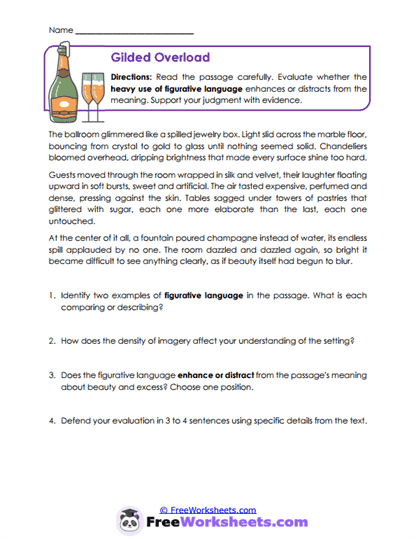
This worksheet helps students understand how too much descriptive language can affect meaning in a story. It focuses on figurative language and asks students to think about whether it adds to or distracts from the message. Your child will learn that while imagery can be powerful, it can also become overwhelming. For example, describing every detail in a rich setting might make it harder to focus on what really matters. This encourages students to think critically about how writing choices impact the reader.
Curriculum and Grade Alignment
This worksheet is designed for 12th grade students who are analyzing author’s craft at a deeper level. The main goal is to evaluate how figurative language affects understanding. Before this, students should be able to identify figurative language, and now they are learning to judge its effectiveness. The next step is applying these ideas in their own writing. It aligns with CCSS.ELA-LITERACY.RL.11-12.4. It also supports TEKS standards for evaluating literary techniques.
Student Tasks
On this worksheet, students will read a passage filled with rich and detailed imagery. They will identify examples of figurative language and explain what they describe. Students will then evaluate whether these details help or distract from the meaning of the passage. Some questions ask them to defend their opinion using evidence. This helps build both analysis and reasoning skills.
Common Challenges and Misconceptions
Students may assume all figurative language is always helpful. Some might struggle to explain why something feels overwhelming. Others may give opinions without strong support from the text. It is also common to focus on one example instead of the overall effect. A helpful tip is to ask, “Does this detail help you understand more, or does it make things harder to follow?”
Implementation Guidance
Teachers can use this worksheet during lessons on descriptive writing or author’s craft. It works well as a discussion activity because students may have different opinions. At home, parents can help by asking their child to explain their reasoning. This builds confidence in forming and defending ideas. Even comparing different answers can deepen understanding.
Details and Features
This worksheet includes a vivid passage and several evaluation-based questions. It encourages students to think critically, not just identify devices. The format is clear and easy to follow. It supports both written responses and discussion. The content challenges students to think more deeply about writing choices.