
About This Worksheet
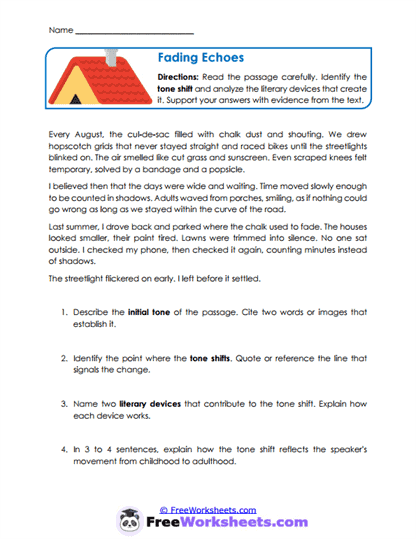
This worksheet helps students understand how tone changes in a story and how that shift affects meaning. Tone is the feeling or attitude the writer creates, and it can change as the story moves forward. Your child will learn how authors use details, images, and language to move from one feeling to another. For example, a story may begin with warm, happy memories and slowly shift into something quieter and more reflective or even sad. This helps students see how stories can grow and change emotionally.
Curriculum and Grade Alignment
This worksheet is designed for 12th grade students working on deeper literary analysis. The main goal is to identify tone and understand how it shifts throughout a passage. Before this, students should be able to recognize basic tone, and now they are learning to track changes and explain why they happen. The next step is connecting tone shifts to theme and meaning. It aligns with CCSS.ELA-LITERACY.RL.11-12.4 and RL.11-12.5. It also supports TEKS standards related to tone and literary devices.
Student Tasks
On this worksheet, students will read a passage that reflects on childhood memories and change. They will identify the tone at the beginning and find where it starts to shift. Students must use specific words or phrases from the text to support their answers. Some questions ask them to explain how literary devices help create this shift. This encourages careful reading and thoughtful explanation.
Common Challenges and Misconceptions
Students may recognize tone but struggle to explain how it changes. Some might miss the exact moment where the shift happens. Others may give answers that are too general without using text evidence. It is also common to confuse tone with mood. A helpful strategy is to ask, “How does the feeling change from the beginning to the end, and what causes that change?”
Implementation Guidance
Teachers can use this worksheet during lessons on tone and author’s craft. It works well for close reading activities where students take their time analyzing the passage. At home, parents can help by asking their child to describe how the passage feels at different points. This makes the idea of tone more concrete. Talking through each answer can build confidence and understanding.
Details and Features
This worksheet includes a reflective passage and several analysis questions. It focuses on tone and how it develops over time. The format is clear and easy to use. It supports written responses and discussion. The content encourages thoughtful reflection and deeper reading.