
About This Worksheet
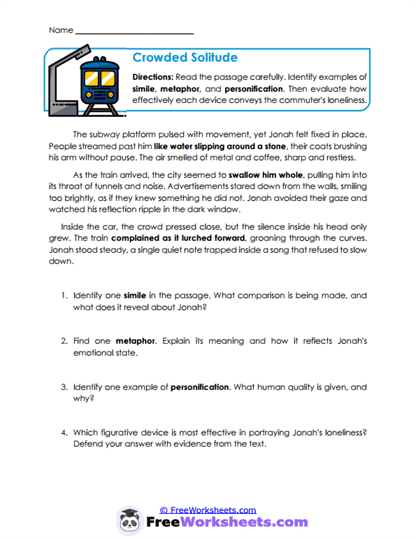
This worksheet helps students understand how figurative language shows emotions in a story. It focuses on simile, metaphor, and personification, which are ways authors compare ideas or give human traits to objects. Your child will learn how these tools help reveal a character’s feelings without saying them directly. For example, saying a crowd moves “like water slipping around a stone” helps show how the character feels isolated. This helps students understand emotional depth in writing.
Curriculum and Grade Alignment
This worksheet is designed for 12th grade students learning advanced literary analysis. The main goal is to identify figurative language and explain its meaning and effect. Before this, students should recognize basic figurative language, and now they are analyzing how it shapes character and mood. The next step is using these techniques in writing. It aligns with CCSS.ELA-LITERACY.RL.11-12.4. It also supports TEKS standards related to figurative language analysis.
Student Tasks
On this worksheet, students will read a passage about a character feeling alone in a crowded place. They will identify one example each of simile, metaphor, and personification. Students must explain what each example means and how it reflects the character’s emotions. Some questions ask them to decide which device is most effective and explain why. This encourages deeper thinking and clear explanation.
Common Challenges and Misconceptions
Students may confuse simile and metaphor or miss subtle examples of personification. Some may identify the device but struggle to explain its deeper meaning. Others might focus on the comparison without connecting it to the character’s feelings. It is also common to give short answers without enough detail. A helpful approach is to ask, “What does this comparison tell us about how the character feels?”
Implementation Guidance
Teachers can use this worksheet during units on figurative language or character analysis. It works well for discussion because students can compare interpretations. At home, parents can support by asking their child to explain each example in simple terms. This helps build confidence and understanding. Talking through answers step by step can make the activity less overwhelming.
Details and Features
This worksheet includes a descriptive passage and targeted questions on figurative language. It is designed to encourage explanation, not just identification. The layout is clear and easy to follow. It supports both written responses and discussion. The topic is relatable and engaging for students.