
About This Worksheet
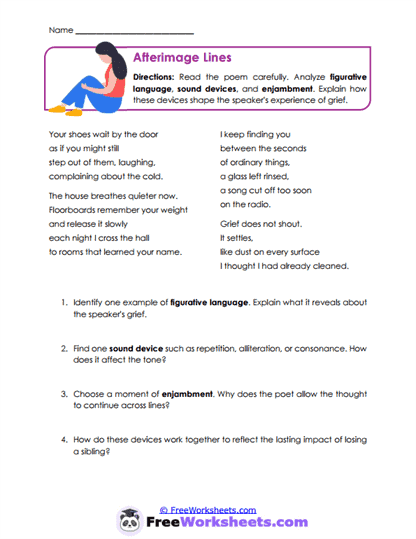
This worksheet helps students explore how poetry uses language and sound to express deep emotions like grief. It focuses on figurative language, sound devices, and enjambment, which is when a sentence continues onto the next line. Your child will learn how poets carefully choose words and structure to create meaning. For example, a line that continues without stopping can show thoughts that feel unfinished or ongoing. This helps students understand how poetry communicates feelings in powerful ways.
Curriculum and Grade Alignment
This worksheet is designed for 12th grade students studying poetry and literary analysis. The main goal is to analyze how different techniques work together to shape meaning. Before this, students should understand basic poetic elements, and now they are learning to analyze them more deeply. The next step is writing their own poetry or literary analysis. It aligns with CCSS.ELA-LITERACY.RL.11-12.4 and RL.11-12.5. It also supports TEKS standards for poetry analysis.
Student Tasks
On this worksheet, students will read a poem about loss and memory. They will identify examples of figurative language and explain what they reveal about the speaker’s feelings. Students will also find a sound device and explain how it affects the tone. Some questions ask them to analyze enjambment and why the poet uses it. This helps students see how structure and meaning work together.
Common Challenges and Misconceptions
Students may find poetry difficult because it feels less direct than other texts. Some may struggle to understand enjambment or how sound devices affect tone. Others might give very general answers without explaining their thinking. It is also common to focus on one device instead of seeing how they all work together. A helpful strategy is to ask, “How does this line sound, and what feeling does it create?”
Implementation Guidance
Teachers can use this worksheet during poetry units or discussions about tone and emotion. It works well for small group analysis where students can share ideas. At home, parents can support by reading the poem aloud with their child. This helps bring out the rhythm and emotion. Talking through each question can make poetry feel more approachable.
Details and Features
This worksheet includes a short poem and several analysis questions. It encourages students to explain their thinking clearly. The format is simple and easy to use. It supports both written responses and discussion. The content is meaningful and encourages reflection.