
About This Worksheet
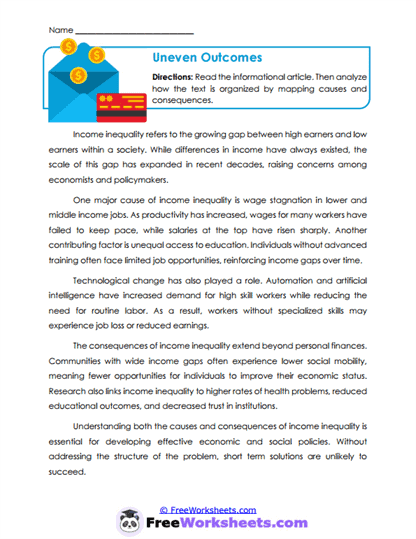
This worksheet helps students understand how informational texts are organized, especially when explaining causes and effects. It focuses on a real-world issue-income inequality-and how different factors connect over time. Students learn to track how one problem leads to another and how ideas build across a passage. For example, limited access to education can lead to fewer job opportunities, which then affects income. This helps students see the bigger picture in complex topics.
Curriculum and Grade Alignment
This worksheet is designed for 12th grade students working on advanced reading comprehension skills. The main goal is to understand how ideas are connected through cause-and-effect relationships. Before this, students should understand basic text structure, and now they are analyzing how those structures shape meaning. The next step is applying this understanding in writing and research. It aligns with CCSS.ELA-LITERACY.RI.11-12.5, which focuses on analyzing text structure. It also supports TEKS standards related to informational text analysis.
Student Tasks
On this worksheet, students will read an informational passage about income inequality. They will identify causes and explain the effects described in the text. Students also look at how different ideas connect and build on each other. Some questions ask them to think about long-term consequences. This helps students organize information and understand complex relationships.
Common Challenges and Misconceptions
Students may focus on one detail without seeing how it connects to the bigger idea. Some might confuse causes with effects or mix up the order. Others may find it difficult to follow multiple ideas at once in a longer passage. It is also common for students to miss long-term impacts mentioned in the text. A helpful tip is to have students map out the cause-and-effect chain step by step.
Implementation Guidance
Teachers can use this worksheet during units on informational texts or social issues. It works well as practice for organizing ideas and understanding structure. At home, parents can use it to help students talk through how one event leads to another. This builds both reading and reasoning skills. Even drawing a simple diagram together can make the ideas clearer.
Details and Features
This worksheet includes a detailed informational passage and structured questions. It is designed to help students break down complex ideas into manageable parts. The format is clean and easy to print. It supports written responses and discussion. The topic is relevant and encourages critical thinking about real-world issues.