
About This Worksheet
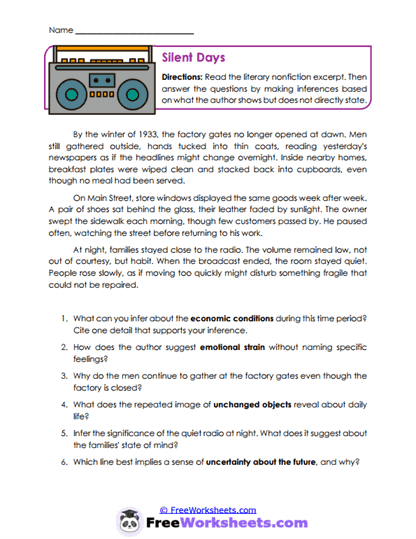
This worksheet is designed to help students learn how to make inferences, which means figuring out ideas that are not directly stated. The passage gives small details about daily life, and students must read carefully to understand the bigger picture. It focuses on a historical setting where things have quietly changed, and students must notice those clues. For example, empty streets and quiet homes suggest something serious has happened, even if it is not said outright. This helps students become stronger readers who can think beyond the surface.
Curriculum and Grade Alignment
This worksheet is meant for 12th grade students who are working on deeper reading comprehension skills. The main goal is to help them support their ideas using evidence from the text. Before this, students should be able to identify key details, and now they are learning how to connect those details to bigger ideas. The next step is analyzing themes and author intent more deeply. It aligns with CCSS.ELA-LITERACY.RI.11-12.1, which focuses on citing strong textual evidence. It also supports TEKS standards for making and supporting inferences.
Student Tasks
On this worksheet, students will read a short passage about life during a difficult time period. They will answer questions that ask them to infer what is happening based on clues in the text. Students must find specific details that support their answers. Some questions also ask them to think about emotions and tone, which are not directly stated. This encourages students to slow down and really think about what they are reading.
Common Challenges and Misconceptions
Students often think an inference is just a guess, but it really needs to be based on evidence. Some may struggle to connect small details to a larger idea. Others might overlook important clues because they read too quickly. It is also common for students to rely on their own opinions instead of the text. A helpful tip is to ask students, “What in the passage made you think that?” so they stay focused on evidence.
Implementation Guidance
Teachers can use this worksheet during literature or history lessons to build deeper thinking skills. It works well for small group discussions where students can share different ideas. At home, parents can use it to practice careful reading and talking through answers. This can turn into a meaningful conversation about how people experience change. Taking time to explain answers out loud can really strengthen understanding.
Details and Features
This worksheet includes a rich, descriptive passage and several inference-based questions. The questions are open-ended, encouraging students to explain their thinking clearly. The layout is simple and easy to print. It supports both written work and discussion. The topic is engaging and encourages thoughtful reflection.