
About This Worksheet
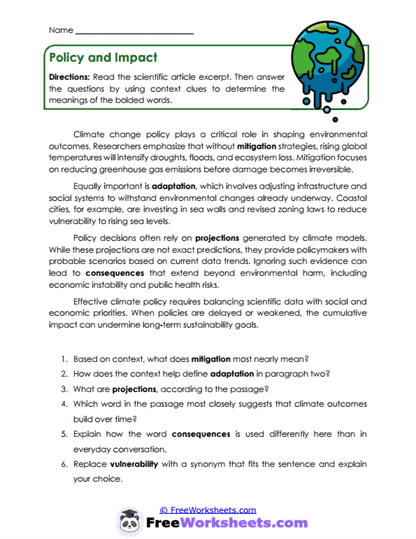
This worksheet helps students learn how to figure out the meaning of difficult words by using the sentences around them. This skill is called using context clues, and it is very important for understanding harder reading, especially in science and informational texts. The passage talks about climate policy, so students are working with real-world, academic language. For example, a word like “mitigation” might seem confusing at first, but by reading the sentence carefully, students can understand it means reducing harm. This kind of thinking helps students become more independent readers.
Curriculum and Grade Alignment
This activity is designed for 12th grade students who are expected to handle complex texts on their own. The main goal is to strengthen vocabulary skills by using context instead of relying on a dictionary right away. Before this, students should already know basic strategies like looking at prefixes or suffixes, and this builds on that by focusing on meaning within a passage. The next step is applying this skill across all subjects, especially science and history. It aligns with CCSS.ELA-LITERACY.RI.11-12.4, which focuses on determining word meanings in context. It also connects to TEKS standards for understanding academic vocabulary.
Student Tasks
On this worksheet, students will read a science-based passage about climate policy and environmental change. They will focus on bolded words and use the surrounding sentences to figure out what those words mean. Students must explain their thinking, not just give a quick definition. Some questions ask them to compare how words are used in different ways. This helps them see that words can have slightly different meanings depending on context.
Common Challenges and Misconceptions
Many students want to guess the meaning of a word too quickly without reading carefully. Others may focus only on the sentence the word is in, instead of looking at the whole paragraph for clues. Some students also confuse similar academic words, especially in science topics. It’s common for them to feel unsure when the vocabulary feels unfamiliar. A helpful strategy is to remind students to slow down and ask, “What is happening in this paragraph, and how does this word fit in?”
Implementation Guidance
Teachers can use this worksheet during reading or science lessons when students are working with informational texts. It works well as guided practice before asking students to read independently. At home, parents can use this to help their child feel more confident with harder vocabulary. Even talking through one word at a time can make a big difference. This is a great way to show students that they don’t need to know every word right away to understand a passage.
Details and Features
This worksheet includes a detailed informational passage and a set of focused vocabulary questions. The format is clear and easy to follow, which helps students stay organized in their thinking. It is designed for written responses so students can explain their reasoning. The content connects to real-world issues, making it more meaningful. It works well for both independent practice and guided instruction.