
About This Worksheet
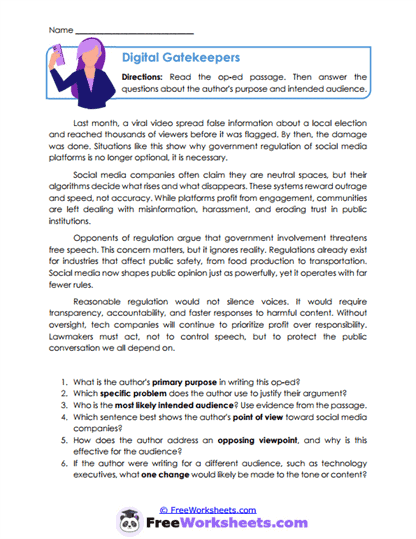
This worksheet is all about helping your student understand how people share opinions and arguments, especially online. It focuses on something called an argumentative text, which is a type of writing where the author is trying to convince the reader to believe something. Your child will learn how to figure out what the author really wants the reader to think and why. For example, a writer might say social media is “neutral,” but then show how it actually shapes people’s opinions-that shift is what students learn to notice. This kind of thinking is very important today because students see these kinds of messages every day.
Curriculum and Grade Alignment
This activity is designed for 12th grade students who are working on strong reading and thinking skills before graduation. The main goal is helping them break down an author’s argument and understand their purpose and point of view. Before this, students should already know how to find the main idea, and this builds on that by asking, “Why did the author write this?” Next, students will move into comparing different arguments and forming their own opinions. This aligns with CCSS.ELA-LITERACY.RI.11-12.6, which focuses on understanding an author’s purpose and point of view. It also connects to TEKS standards that ask students to analyze persuasive writing and real-world texts.
Student Tasks
On this worksheet, students will read a short opinion piece about social media and how it influences people. They will answer questions that ask them to figure out what the author believes and what they want the reader to believe. Students also look at how the author supports their ideas and whether those ideas are fair or one-sided. They will think about who the author is writing for and how that affects the message. By the end, they even consider how the message might change if the audience were different, which is a higher-level thinking skill.
Common Challenges and Misconceptions
Many students think if something is written confidently, it must be true, and that can cause confusion here. Some may mix up facts and opinions, especially when the author blends them together. Others might have trouble seeing that the author is trying to persuade, not just inform. It’s also common for students to miss who the message is really meant for, which is key to understanding the purpose. A helpful way to support your child is to ask simple questions like, “What is the writer trying to make you believe?” and talk it through together.
Implementation Guidance
In the classroom, teachers often use this type of worksheet when talking about media, news, or online information. It works well before a class discussion or debate because it gets students thinking deeply about real issues. At home, you can use it as a way to talk about things your child sees online and help them think more carefully about them. This is not just school learning-it’s a life skill. Even just sitting with your child and asking them to explain their answers can make a big difference.
Details and Features
This worksheet includes a short reading passage and a set of thoughtful questions that go beyond basic answers. It is designed to make students explain their thinking, not just pick an answer. The layout is simple and easy to print, so it works well in both classrooms and at home. It can be used for independent work or small group discussion. The questions are open-ended, which helps students build strong writing and thinking skills.