
About This Worksheet
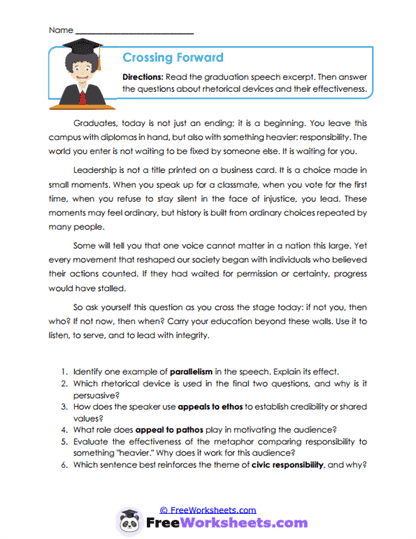
This worksheet helps students understand how speeches are written to inspire and motivate people. It focuses on something called rhetorical devices, which are special ways speakers use language to make their message stronger. Your child will learn how speeches are carefully built to connect with an audience and encourage action. For example, when a speaker repeats a phrase like “Now is the time,” it builds energy and pushes listeners to act-that’s a technique students will study here. This is especially meaningful because the passage is based on a graduation speech, something many students can relate to.
Curriculum and Grade Alignment
This worksheet is meant for 12th grade students who are learning how powerful language can be in speeches. The main goal is to help them recognize techniques like repetition, emotional appeal, and credibility. Students should already understand basic figurative language, and this takes them one step further into analyzing real-world communication. After this, students often move into writing their own speeches or presentations. It aligns with CCSS.ELA-LITERACY.RI.11-12.6 and speaking/listening standards focused on analyzing arguments. It also supports TEKS standards around understanding persuasive communication.
Student Tasks
On this worksheet, students will read part of a graduation speech and think about how the speaker is trying to inspire the audience. They will find examples of techniques like repetition and explain why they are effective. Students will also look at how the speaker builds trust and connects emotionally with the audience. Some questions ask them to think more deeply about how the speech motivates people to act. Each answer requires explanation, not just identification, which strengthens their understanding.
Common Challenges and Misconceptions
Students often think identifying a device is enough, but the real challenge is explaining why it works. Some may confuse simple repetition with meaningful rhetorical techniques. Others may not fully understand terms like ethos or pathos, which can make the questions harder. It’s also easy for students to miss how the speech is meant to make people feel. A good way to help is to ask, “How does this line make you feel, and why do you think the speaker chose those words?”
Implementation Guidance
Teachers can use this worksheet when studying speeches, especially before students write their own. It works well as a class discussion starter because students can share how different parts of the speech affected them. At home, parents can use it to talk about leadership, responsibility, and growing up. This makes the learning feel more personal and meaningful. Even reading the speech out loud together can help students better understand its impact.
Details and Features
This worksheet includes a meaningful speech excerpt and several thoughtful questions. It is designed to build both reading and speaking awareness. The format is clear and easy to follow, making it simple to use in different settings. It encourages students to explain their thinking in full sentences. The content is engaging and connects well to real-life experiences like graduation.