
About This Worksheet
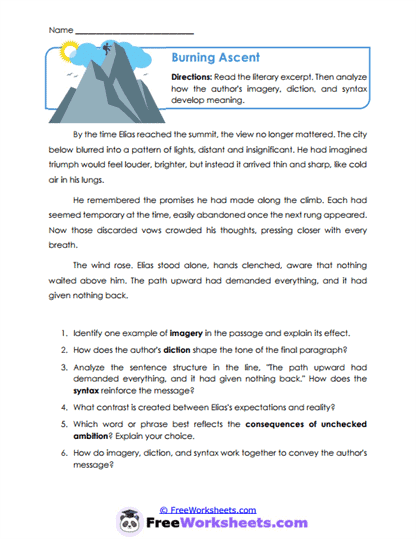
This worksheet focuses on helping students understand how authors use language to create meaning in a story. It looks closely at imagery, diction, and sentence structure, which are all tools writers use to shape how a reader feels. Students will explore how word choices and descriptions build a deeper message about ambition and consequence. For example, describing the air as “thin and sharp” helps show discomfort and struggle without saying it directly. This kind of analysis helps students appreciate how writing works on a deeper level.
Curriculum and Grade Alignment
This worksheet is designed for 12th grade students studying advanced literary analysis. The main goal is to help them understand how different writing techniques work together to create meaning. Before this, students should recognize basic literary elements, and now they are learning to analyze how those elements interact. The next step is applying these ideas in their own writing and essays. It aligns with CCSS.ELA-LITERACY.RL.11-12.4, which focuses on analyzing word choice and tone. It also supports TEKS standards related to literary analysis and interpretation.
Student Tasks
On this worksheet, students will read a descriptive literary passage about a character reaching a mountain summit. They will identify examples of imagery and explain how those details affect the reader. Students also analyze how word choice shapes the tone of the passage. Some questions ask them to look closely at sentence structure and explain its impact. Each task requires students to explain their thinking clearly and connect it back to the text.
Common Challenges and Misconceptions
Students may find it easy to point out descriptive language but harder to explain why it matters. Some may confuse imagery with simple description without thinking about its deeper effect. Others might overlook how sentence structure changes the pacing or tone. It is also common for students to give surface-level answers instead of deeper analysis. A helpful strategy is to ask, “How does this make the reader feel, and why did the author choose these words?”
Implementation Guidance
Teachers can use this worksheet during a literature unit focused on author’s craft. It works well as practice before writing literary analysis essays. At home, parents can help by asking their child to describe what they picture while reading. This makes the passage more real and easier to understand. Taking time to talk through one question at a time can build confidence.
Details and Features
This worksheet includes a vivid literary passage and several open-ended analysis questions. It encourages deeper thinking and detailed written responses. The layout is clear and easy to follow. It supports both independent work and guided discussion. The content is engaging and challenges students to think critically.