
About This Worksheet
This worksheet helps your student understand how authors share opinions on serious, real-world topics like immigration. It focuses on something called perspective, which means the author’s point of view and how they see an issue. Students will learn that writers don’t always present every side equally, and that matters when reading. For example, a writer might focus more on safety concerns and give less attention to humanitarian ideas, shaping how the reader feels. This kind of awareness helps students become more thoughtful and careful readers.
Curriculum and Grade Alignment
This activity is designed for 12th grade students who are learning to analyze complex texts and opinions. The main goal is to help them identify an author’s perspective and understand how it is supported. Before this, students should be able to find the main idea, and now they are learning to ask, “What is the author really trying to say?” The next step is comparing multiple viewpoints and forming their own arguments. It aligns with CCSS.ELA-LITERACY.RI.11-12.6, which focuses on analyzing point of view. It also connects to TEKS standards that involve evaluating bias and perspective in texts.
Student Tasks
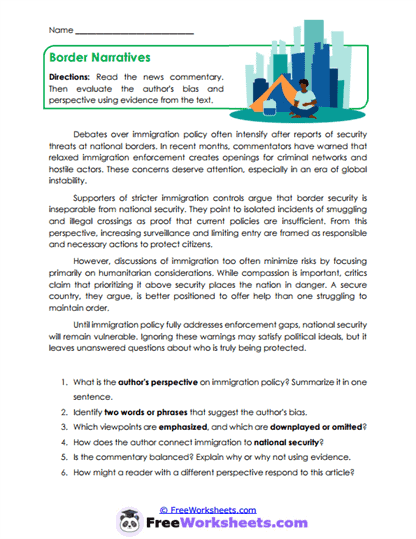
On this worksheet, students will read a commentary about immigration policy and border security. They will identify the author’s main perspective and explain it in their own words. Students will also find specific words or phrases that show bias or emphasis. Some questions ask them to think about what viewpoints are missing or not fully explained. This encourages students to think more deeply about fairness and balance in writing.
Common Challenges and Misconceptions
Students often think that all texts are neutral, especially if they sound formal or serious. Some may have trouble spotting bias when it is not obvious. Others might confuse their own opinion with the author’s perspective. It is also common for students to overlook what is left out of a text, which can be just as important as what is included. A helpful approach is to ask, “Whose voice is strong here, and whose voice is missing?”
Implementation Guidance
Teachers can use this worksheet during lessons on current events or media literacy. It works well as a starting point for class discussions where students can share different viewpoints. At home, parents can use it to talk about how news and opinions are presented. This helps students see that reading is not just about understanding words, but also understanding ideas. Even simple conversations about fairness and bias can make a big impact.
Details and Features
This worksheet includes a real-world style passage and several thoughtful questions. It encourages students to explain their thinking, not just give quick answers. The format is clean and easy to use in both classroom and home settings. It supports critical thinking and discussion. The topic is relevant and meaningful for older students preparing to engage with real-world issues.