
About This Worksheet
This worksheet is a persuasive text analysis activity that helps students understand how appeals are used to influence an audience. It is designed for 12th-grade students and focuses on emotional and logical appeals in writing. Students learn how authors use values, beliefs, and evidence to motivate readers. For example, a message about fairness in education can appeal to both emotion and logic to encourage support.
Curriculum and Grade Alignment
This worksheet aligns with Common Core standard CCSS.ELA-LITERACY.RI.11-12.6, which focuses on analyzing author’s purpose and perspective. It also supports CCSS.ELA-LITERACY.RI.11-12.8 by evaluating arguments and appeals. Students should already understand basic persuasive techniques before completing this task. This prepares them for advanced argument analysis and writing. It also connects to TEKS ELAR 12.6, which focuses on analyzing arguments and reasoning.
Student Tasks
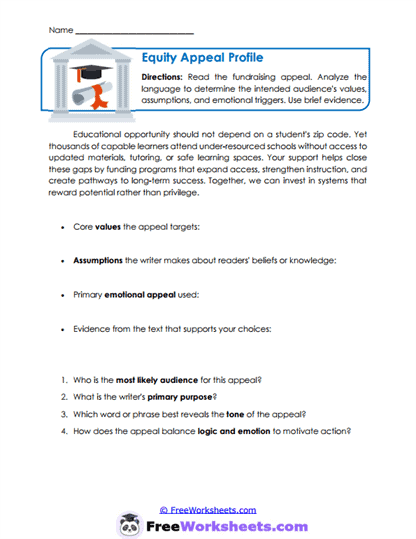
On this worksheet, students will read a fundraising appeal about educational opportunity. They identify the values the appeal is targeting and the assumptions it makes about readers. Students also determine the main emotional appeal used in the message. In the final questions, they explain who the audience is and how the appeal motivates action.
Common Challenges and Misconceptions
Students may focus only on emotional language and miss logical reasoning. Some might struggle to identify assumptions about the audience. Others may give general answers without using evidence. Teachers can help by guiding students to look at both emotion and logic together.
Implementation Guidance
Teachers can use this worksheet during lessons on persuasive writing or rhetorical analysis. It works well as guided practice or independent work. Parents can use it to help students understand how messages are designed to influence people. This worksheet builds strong critical thinking skills.
Details and Features
The worksheet includes a focused persuasive passage and structured questions. It provides space for both identification and explanation. The format supports organized and thoughtful responses. It is printable and easy to use in different settings.