
About This Worksheet
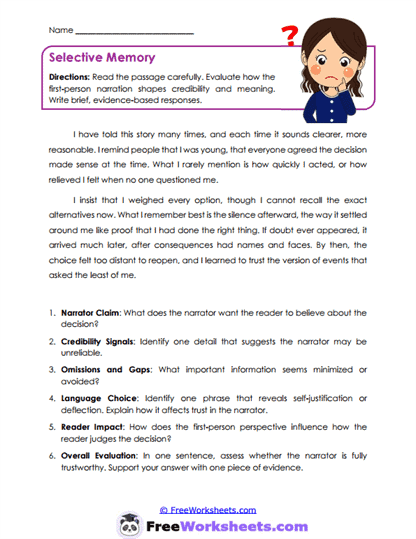
This worksheet is a narrative analysis activity that focuses on narrator reliability and perspective. It is designed for 12th-grade students and helps them understand how memory and bias affect storytelling. Students learn that narrators may shape events to present themselves in a certain way. For example, a narrator may leave out mistakes to seem more responsible.
Curriculum and Grade Alignment
This worksheet aligns with Common Core standard CCSS.ELA-LITERACY.RL.11-12.6, which focuses on analyzing point of view and reliability. It also supports CCSS.ELA-LITERACY.RL.11-12.1 by requiring evidence from the text. Students should already understand first-person narration before completing this task. This prepares them for deeper analysis of bias and perspective. It also connects to TEKS ELAR 12.5, which focuses on analyzing point of view.
Student Tasks
On this worksheet, students will read a passage and identify what the narrator wants the reader to believe. They find details that suggest the narrator may not be fully reliable. Students also identify missing information and explain why it matters. In the final questions, they evaluate whether the narrator can be trusted.
Common Challenges and Misconceptions
Students may assume the narrator is always truthful. Some might miss subtle clues that show bias or omission. Others may struggle to explain how missing details affect meaning. Teachers can help by asking students to compare what is said and what is left out.
Implementation Guidance
Teachers can use this worksheet during lessons on narration or point of view. It works well as a discussion activity or written analysis task. Parents can use it to help students think critically about storytelling. This worksheet builds strong reading and reasoning skills.
Details and Features
The worksheet includes a detailed passage and guided analysis questions. It provides space for complete written responses. The format supports careful thinking about reliability and bias. It is printable and easy to use in different learning environments.