
About This Worksheet
This worksheet is a critical reading activity that teaches students to notice missing perspectives in informational texts. It is designed for 12th-grade students and focuses on understanding how leaving out certain voices can shape an argument. Students learn that what is not said can be just as important as what is included. For example, a report about city traffic may ignore neighborhood concerns, which changes how the issue is understood.
Curriculum and Grade Alignment
This worksheet aligns with Common Core standard CCSS.ELA-LITERACY.RI.11-12.6, which focuses on analyzing point of view and perspective. It also supports CCSS.ELA-LITERACY.RI.11-12.8 by evaluating arguments and how they are presented. Students should already understand basic reading comprehension before completing this activity. This prepares them for analyzing fairness and completeness in texts. It also connects to TEKS ELAR 12.5, which focuses on perspective and bias.
Student Tasks
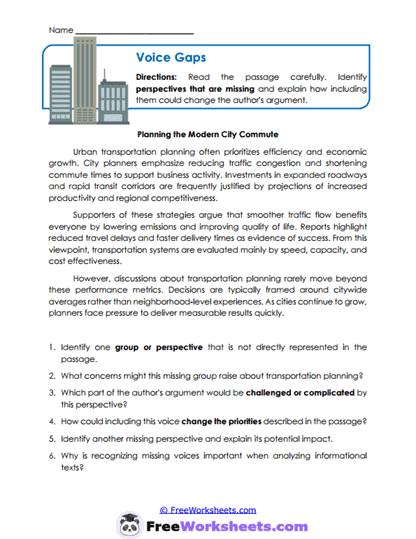
On this worksheet, students will read a passage about urban transportation planning and identify missing perspectives. They explain which groups are not represented and why that matters. Students also consider how adding these voices might change the argument. In the final questions, they reflect on why recognizing missing viewpoints is important.
Common Challenges and Misconceptions
Students may assume that a text includes all important viewpoints. Some might struggle to imagine perspectives that are not directly mentioned. Others may not clearly explain how missing voices affect the argument. Teachers can help by asking students to think about who is impacted but not heard.
Implementation Guidance
Teachers can use this worksheet during lessons on bias, perspective, or informational text analysis. It works well as a discussion activity where students share different viewpoints. Parents can use it to help students think more deeply about fairness in information. This worksheet builds strong critical thinking and awareness skills.
Details and Features
The worksheet includes a focused passage and guided questions about perspective. It provides space for written responses in complete sentences. The format encourages thoughtful reflection and analysis. It is easy to print and suitable for classroom or home use.