
About This Worksheet
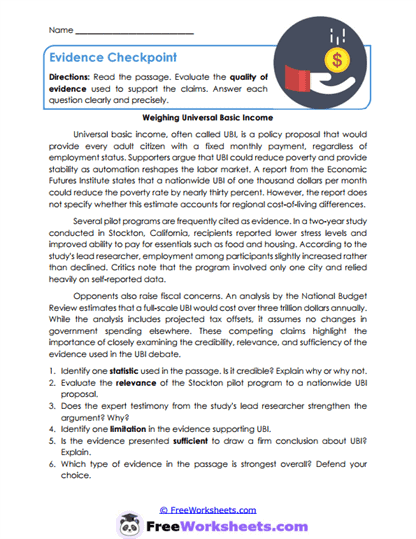
This worksheet is an informational text analysis activity that teaches students how to judge the strength and quality of evidence. It is made for 12th-grade reading and focuses on evaluating claims using facts, data, and reasoning. Students learn to tell the difference between strong, helpful evidence and weak or missing support. For example, a claim like “this plan helps people” becomes stronger when it changes to “this plan helped 80% of people in a study,” showing clear proof.
Curriculum and Grade Alignment
This worksheet aligns with Common Core standard CCSS.ELA-LITERACY.RI.11-12.8, which focuses on evaluating arguments and evidence in a text. It also supports CCSS.ELA-LITERACY.RI.11-12.1 by asking students to use specific details from the passage. Students should already know how to find main ideas before working on this skill. This prepares them for college-level reading where they must judge if information is reliable. It also connects to TEKS ELAR 12.6, which focuses on analyzing arguments and evidence.
Student Tasks
On this worksheet, students will read a passage about universal basic income and think carefully about the evidence used. They identify statistics and decide if those numbers are trustworthy and meaningful. Students also look at expert opinions and decide if they really support the claim being made. In the final questions, they explain limits in the evidence and decide which type of proof is strongest overall.
Common Challenges and Misconceptions
Students may believe that any number or statistic is strong evidence without questioning its source. Some might confuse opinions with facts or assume expert statements are always correct. Others may struggle to explain why evidence is weak instead of just saying it is. A helpful tip is to remind students to always ask, “Where did this information come from and can I trust it?”
Implementation Guidance
Teachers can use this worksheet during lessons on argument writing or informational reading skills. It works well as practice before students write their own essays using evidence. Parents can use it to help students think more carefully about information they read online or in the news. This worksheet builds strong thinking habits that students will use in real life.
Details and Features
The worksheet includes a detailed reading passage along with clear, guided questions. It gives students space to write full answers and explain their thinking. The layout is clean and easy to follow, making it simple to use in class or at home. It is printable and works well for both group and independent work.