
About This Worksheet
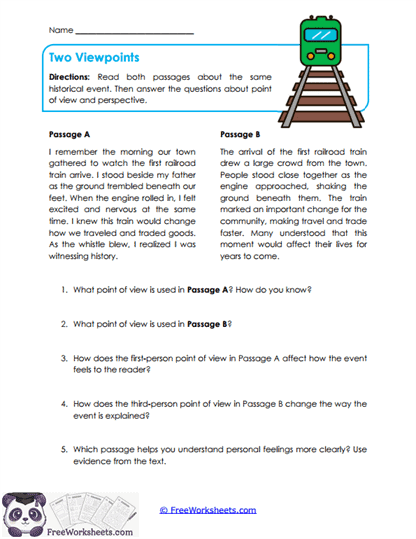
This Grade 5 language arts worksheet helps students compare first-person and third-person point of view by reading two passages about the same historical event. Both selections describe the arrival of the first railroad train, but one is told by a person who experienced the event and the other is told by an outside narrator.
This is especially useful because students can see how point of view changes what information a reader receives. One version gives personal feelings and reactions, while the other explains the event more broadly.
Learning Goals
The main goal is to help students identify point of view and understand how it affects the way a story or event is presented.
Children practice recognizing first-person clues such as I and we, comparing those with third-person narration, and thinking about how each perspective changes the reader’s understanding.
This supports literary analysis, historical reading, and comprehension of narrator perspective.
What Students Will Do
Students read Passage A and Passage B, both about the railroad’s arrival.
Then they answer five questions.
They identify the point of view in Passage A and explain how they know, identify the point of view in Passage B, explain how first person changes the emotional feeling of the event, explain how third person changes the way the event is described, and decide which passage helps the reader understand personal feelings more clearly.
Students must use evidence from the passages to support their answers.
Common Challenges
Some students may identify the point of view correctly but struggle to explain its effect.
A parent or teacher can ask, “What can Passage A tell us because the speaker was actually there?” Then ask, “What can Passage B explain more easily because the narrator is outside the event?”
Another challenge is confusing the topic with the point of view. Both passages are about the same event, but the narrator is different.
Teaching Suggestions
Have students circle pronouns in each passage before answering the questions. Words such as I and we make first person easy to spot.
Teachers can also create a two-column chart labeled Personal Experience and Outside Explanation and have students place details from each passage in the correct column.
For stronger students, ask them to rewrite one sentence from Passage B in first person.
Worksheet Features
The page includes two short passages about the same historical event and five comparison questions focused on narrator perspective and reader experience.
This worksheet works well for point-of-view lessons, paired-text practice, reading groups, homework, or Grade 5 literary review.