
About This Worksheet
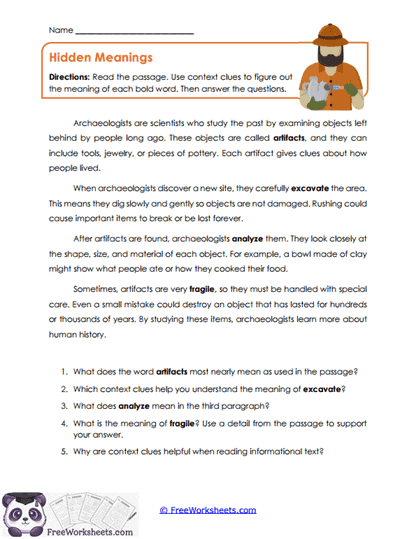
This Grade 5 vocabulary and reading worksheet helps students figure out the meanings of unfamiliar academic words by using context clues. The passage introduces archaeology and includes bold words such as artifacts, excavate, analyze, and fragile.
Instead of giving students the definitions first, the passage provides clues through explanations, examples, and details. Students have to use those clues to work out what each word means. This is an important reading habit because fifth graders regularly meet new vocabulary in science, history, and informational texts.
Learning Goals
The main goal is to help students determine word meaning from context.
Children practice looking at the sentences around a difficult word, finding clues that explain or describe it, and using those details to build a meaning.
They also learn that context clues may appear before or after the unfamiliar word and that a strong answer should be supported by something specific in the passage.
What Students Will Do
Students read an informational passage about archaeologists and how they study objects from the past.
As they read, they come across several bold vocabulary words. The text explains that artifacts are objects left behind by people, that archaeologists carefully excavate a site, that they analyze objects closely, and that some items are fragile and must be handled with care.
After reading, students answer five questions. They define artifacts, identify clues that explain excavate, explain analyze, determine the meaning of fragile using a detail from the passage, and explain why context clues are useful in informational reading.
Common Challenges
Some students may give a definition from memory but not use the clues in the passage. The goal here is to show how the text itself helps reveal the meaning.
Others may copy an entire sentence without explaining what the word means. A parent or teacher can ask, “What does that clue tell you in simpler words?”
Students may also struggle to separate the definition from the evidence. Encourage them to answer with both: what the word means and which part of the passage helped them know.
Teaching Suggestions
Teachers can model one word by covering it and reading the surrounding sentence aloud. Ask, “What could fit here and still make sense?”
Parents can encourage students to look for clue words such as descriptions, examples, or explanations around the bold term.
For stronger readers, ask them to replace one bold word with a synonym and decide whether the sentence still keeps the same meaning.
Worksheet Features
The page includes one archaeology-themed informational passage and five questions that focus directly on vocabulary in context.
This worksheet works well for context-clue instruction, nonfiction reading, vocabulary review, homework, or cross-curricular language arts practice.