
About This Worksheet
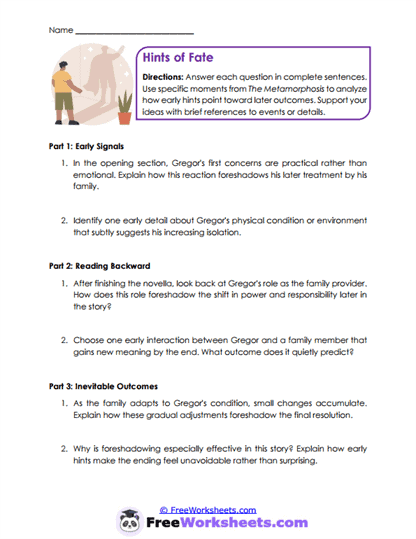
Hints of Fate is a Grade 12 literary analysis worksheet centered on Franz Kafka’s The Metamorphosis. This resource focuses specifically on the technique of foreshadowing and how subtle early signals shape the reader’s understanding of Gregor Samsa’s inevitable decline. Rather than treating the novella’s conclusion as abrupt or shocking, this worksheet guides students to trace the structural and emotional groundwork that makes the ending feel tragically unavoidable.
Students are asked to analyze early physical details, family dynamics, and environmental cues that quietly predict Gregor’s increasing isolation. The worksheet emphasizes interpretive reading-students must move beyond surface events and evaluate how Kafka plants narrative seeds that only gain full meaning in hindsight. The structure encourages backward analysis, requiring students to reconsider early scenes through the lens of the ending.
Curriculum and Grade Alignment
This worksheet is designed for Grade 12 and emphasizes advanced narrative analysis, foreshadowing, and structural development. The primary learning goal is to evaluate how Kafka uses subtle details to prepare readers for thematic resolution.
Students should already be proficient in identifying literary devices. The next progression skill involves tracing how techniques operate across an entire text rather than within a single scene. This resource aligns with CCSS.ELA-LITERACY.RL.11-12.2, RL.11-12.3, and RL.11-12.5.
Student Tasks
In Part 1, students analyze Gregor’s initial reaction to his transformation, noting how his practical concerns about work foreshadow his family’s utilitarian treatment of him. They also identify physical or environmental details-such as his locked door or darkened room-that hint at growing separation.
In Part 2, students reread Gregor’s role as financial provider and explain how this power dynamic predicts later shifts in authority. They select one interaction that gains new meaning when viewed from the ending and analyze how it quietly predicts the outcome.
In Part 3, students examine the family’s gradual emotional withdrawal and explain how incremental changes build toward the final resolution. They evaluate why foreshadowing makes the ending feel inevitable rather than random.
Common Challenges and Misconceptions
Students may focus only on dramatic moments instead of subtle early signals. Others may treat foreshadowing as obvious prediction rather than layered suggestion. Teachers can model how to connect Gregor’s initial self-sacrifice to the family’s final detachment.
Implementation Guidance
This worksheet is most effective after students complete the novella. It can serve as preparation for an analytical essay on inevitability, alienation, or existentialism.
Details and Features
Organized into three progressive sections-early signals, retrospective analysis, and thematic inevitability. Requires textual references and interpretive explanation in complete sentences.