
About This Worksheet
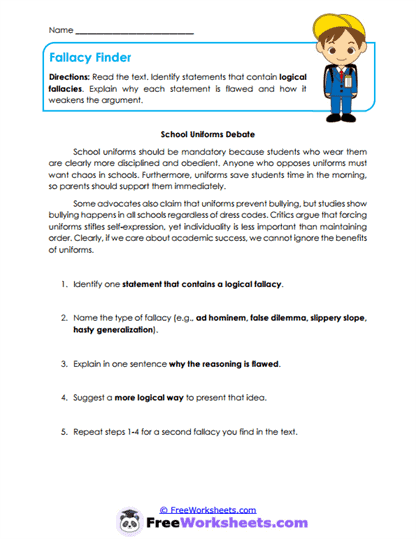
Fallacy Finder is a grade 12 critical reasoning worksheet focused on identifying and analyzing logical fallacies in argumentative writing. It is a high school literacy resource that strengthens students’ ability to detect flawed reasoning and explain how it weakens persuasion. The passage, School Uniforms Debate, includes exaggerated claims, sweeping generalizations, and false cause reasoning. Students must locate specific flawed statements, name the type of fallacy, and propose a more logical revision.
Curriculum and Grade Alignment
This worksheet is designed for Grade 12 and emphasizes evaluating the validity of reasoning within argumentative texts. The primary learning goal is to identify fallacies such as hasty generalization, false dilemma, slippery slope, and ad hominem reasoning. Students should already understand the structure of arguments and common persuasive strategies. The next progression skill involves critiquing arguments in academic essays and public discourse. This resource aligns with CCSS.ELA-LITERACY.RI.11-12.8.
Student Tasks
Students identify one statement containing a logical fallacy and name the type. They explain in one concise sentence why the reasoning is flawed and suggest a more logically sound revision. They then repeat the process for a second fallacy within the text. Each response requires precise explanation and clear reasoning rather than vague criticism.
Common Challenges and Misconceptions
Students may mislabel fallacies without explaining how the reasoning fails. Some may confuse strong opinion with flawed logic. Others may struggle to propose a corrected version that removes the fallacy. Teachers can model how to isolate the flawed assumption within a claim.
Implementation Guidance
This worksheet works well in advanced rhetoric or debate units. Teachers can extend the activity by having students analyze fallacies in editorials or political advertisements.
Details and Features
The worksheet includes a short argumentative passage and five structured analysis steps. Prompts require identification, classification, explanation, and revision. The printable format supports detailed analytical responses suited for Grade 12 rigor.