
About This Worksheet
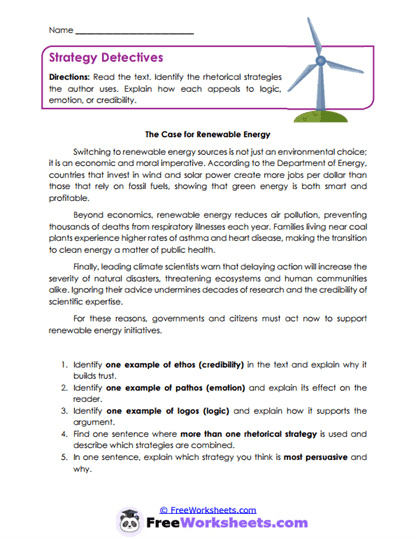
Strategy Detectives is a grade 12 rhetorical analysis worksheet focused on identifying and evaluating persuasive strategies in argumentative writing. It is a high school literacy resource that requires students to analyze appeals to ethos, pathos, and logos within a policy argument. The passage, The Case for Renewable Energy, blends statistical claims about job growth, health-related impacts of pollution, and expert testimony from climate scientists. Students must not only locate examples of each appeal but explain how these strategies function together to persuade readers.
Curriculum and Grade Alignment
This worksheet is designed for Grade 12 and emphasizes evaluating rhetorical appeals and explaining how they interact within an argument. The primary learning goal is to analyze how credibility, logic, and emotion operate individually and in combination. Students should already be able to identify rhetorical appeals. The next progression skill involves composing rhetorical analyses that assess overall persuasive effectiveness. This resource aligns with CCSS.ELA-LITERACY.RI.11-12.8.
Student Tasks
Students identify one example each of ethos, pathos, and logos and explain how each builds the argument. They analyze one sentence where multiple strategies overlap and evaluate how combining appeals strengthens persuasion. Finally, students determine which appeal is most persuasive and justify their reasoning with textual evidence.
Common Challenges and Misconceptions
Students may label appeals without explaining their impact. Some may assume emotional appeals weaken arguments without evaluating context. Others may struggle to analyze how strategies combine within a single sentence. Teachers can model breaking down complex persuasive passages.
Implementation Guidance
This worksheet works well in advanced rhetoric or AP Language units. Teachers may extend the activity by having students rewrite a paragraph emphasizing a different appeal.
Details and Features
The worksheet includes an argumentative text and five in-depth rhetorical analysis prompts. Questions require explanation of persuasive impact and strategy interaction. The layout supports detailed analytical responses.