
About This Worksheet
This worksheet is a reading analysis activity that helps students see how tone supports or weakens an argument. It is designed for 12th-grade students and focuses on connecting tone, purpose, and central claim. Students learn that how something is said can change how convincing it feels. For example, a claim like “testing is harmful” sounds stronger when paired with a serious or critical tone instead of a neutral one.
Curriculum and Grade Alignment
This worksheet aligns with Common Core standard CCSS.ELA-LITERACY.RI.11-12.6, which focuses on analyzing author’s purpose and tone. It also supports CCSS.ELA-LITERACY.RI.11-12.8 by evaluating arguments. Students should already understand how to find a central claim before completing this activity. This prepares them for deeper analysis of persuasive writing. It also connects to TEKS ELAR 12.6, which focuses on analyzing arguments and reasoning.
Student Tasks
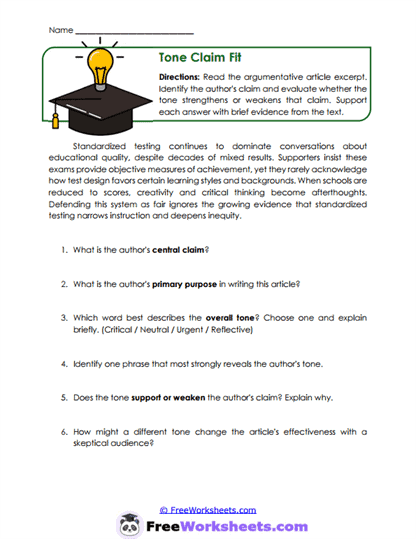
On this worksheet, students will read an argumentative passage about standardized testing. They identify the author’s central claim and explain the main purpose of the text. Students choose a word that best describes the tone and support their answer with evidence. They also explain whether the tone strengthens or weakens the argument.
Common Challenges and Misconceptions
Students may identify tone correctly but struggle to explain how it affects the claim. Some might confuse tone with opinion or topic. Others may give answers without using text evidence. Teachers can help by modeling how tone and purpose work together.
Implementation Guidance
Teachers can use this worksheet during lessons on persuasive writing or argument analysis. It works well as a guided discussion or independent activity. Parents can use it to help students understand how tone influences meaning. This worksheet builds strong reasoning and reading skills.
Details and Features
The worksheet includes a focused passage and structured questions. It provides space for short, clear written responses. The format encourages evidence-based thinking. It is printable and easy to use in different learning settings.