
About This Worksheet
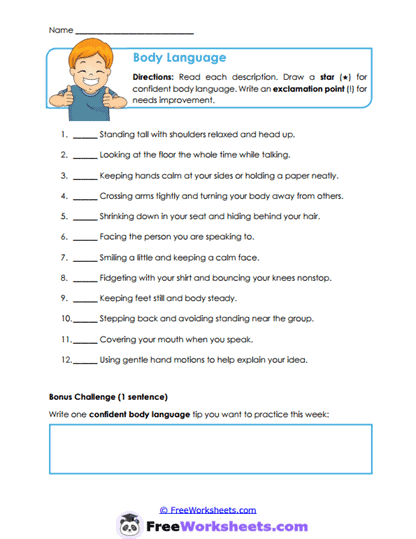
This worksheet is a social-emotional learning activity that helps students understand how body language affects communication. It focuses on recognizing confident versus unconfident physical behaviors. The subject area is SEL and communication, designed for grades 3-6. Students learn that posture, movement, and facial expressions all send messages. For example, “standing tall with shoulders relaxed” shows confidence, while “looking at the floor” may not.
Curriculum and Grade Alignment
This worksheet supports students in developing awareness of nonverbal communication. It builds on basic social skills and introduces self-monitoring strategies. Students should already understand simple communication behaviors before completing this activity. The next step is applying these skills in real conversations. It aligns with CCSS.ELA-LITERACY.SL.3.1 and TEKS 110.6(b)(1), which focus on effective communication.
Student Tasks
On this worksheet, students will read descriptions of different body language behaviors. They will mark which ones show confidence and which need improvement. Students also complete a bonus reflection about a skill they want to practice. As they work, they think about how their body language affects others. This builds awareness and self-reflection.
Common Challenges and Misconceptions
Some students may not recognize subtle body language cues. Others might think all movement shows confidence, even when it does not. It’s also common to misunderstand how posture affects communication. A few students may struggle to reflect on their own habits. Demonstrating examples can help students better understand the concepts.
Implementation Guidance
Teachers can use this worksheet during SEL lessons or before presentations. It works well as part of a larger discussion about communication skills. Parents can use it at home to talk about posture and eye contact. Practicing these skills in everyday situations can make a big difference. This activity helps students become more aware of how they present themselves.
Details and Features
The worksheet includes a variety of clear and relatable body language examples. It provides simple marking tasks and a reflection section. The layout is clean and easy to follow. It supports both identification and personal growth. The printable format makes it convenient for classroom or home use.