
About This Worksheet
This worksheet is a distraction identification activity that helps students recognize barriers to active listening. It focuses on both internal and external distractions that affect communication. Students read short scenarios and identify what is preventing effective listening. For example, checking a phone becomes an external distraction, while daydreaming becomes an internal distraction. This builds awareness of focus and attention skills.
Curriculum and Grade Alignment
This worksheet is appropriate for grades 4 through 7 and supports attention and communication skills within social-emotional learning. The primary goal is to help students identify and reduce distractions. Students should already understand basic listening expectations. It aligns with CCSS.SL.4.1, which focuses on collaborative discussions. In Texas, it connects to TEKS 110.6(b)(1) related to listening behaviors.
Student Tasks
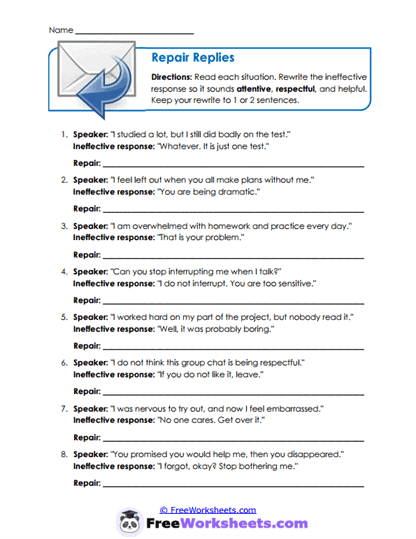
On this worksheet, students will read different scenarios and identify the type of distraction present. They will determine whether each distraction is internal or external. Some responses require explaining how the distraction affects listening. Students must think about real-life situations and apply their understanding. The activity encourages self-awareness and problem-solving.
Common Challenges and Misconceptions
Students may confuse internal distractions with external ones. Some might overlook subtle distractions like thinking about something else. Others may struggle to explain how distractions impact communication. There can also be a tendency to focus only on obvious examples like phones or noise. Teachers should provide clear definitions and examples before starting.
Implementation Guidance
Teachers can use this worksheet during lessons on focus, attention, or classroom expectations. It works well as a reflection activity after group discussions. Students can share personal examples of distractions. At home, parents can use it to discuss staying focused during conversations. This activity supports both awareness and behavior improvement.
Details and Features
The worksheet includes clear instructions and relatable scenarios for students to analyze. It is formatted for easy printing and classroom use. The layout provides space for written responses. The content is engaging and relevant to everyday experiences. It is ideal for independent or guided practice.