
About This Worksheet
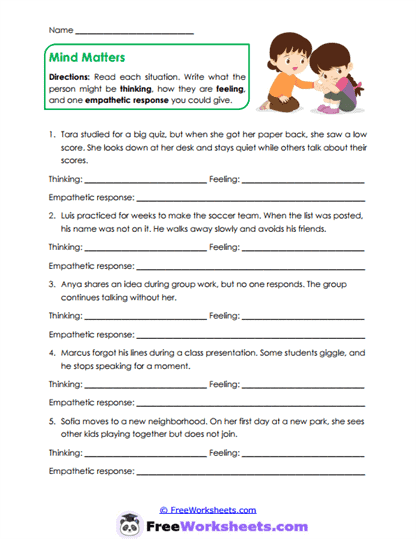
This worksheet helps students think about what another person may be feeling and thinking when the full story is not obvious. Children read five situations involving a disappointing grade, missing a sports team, being ignored during group work, forgetting lines during a presentation, and feeling left out in a new neighborhood. For each situation, they identify the person’s likely thoughts and emotions, then write an empathetic response. The activity teaches children to look beneath visible behavior and consider the private worries, embarrassment, disappointment, or loneliness that may be present.
Skills Developed
Students develop emotional reasoning, perspective-taking, supportive communication, and social awareness. They practice separating what happened from what the person may be telling themselves about the experience. The worksheet also helps students respond in ways that validate feelings without criticizing, dismissing, or immediately trying to fix everything. These skills can make children more patient and thoughtful when a peer becomes quiet, withdrawn, embarrassed, or discouraged.
Grade & Stage Appropriateness
This worksheet is best suited for upper elementary and early middle school students, especially grades 4 through 7. Students in this age range are becoming better able to understand that thoughts, feelings, and outward behavior may be different. Younger students may benefit from a feeling-word bank or teacher modeling, while older students can explore more complex thoughts about failure, rejection, and belonging. The worksheet is especially useful for learners who make quick assumptions about why another person is acting differently.
Connections to Collaborative for Academic, Social and Emotional Learning (CASEL)
This activity aligns closely with the CASEL areas of social awareness, relationship skills, self-management, and responsible decision-making. Students slow down, consider another person’s inner experience, and choose a response that supports rather than judges. In my experience, children often want to offer advice immediately, but advice is not always the first thing someone needs. I use this worksheet to show that empathy may begin with a statement such as “That sounds really disappointing” before moving toward help or solutions.
Using This Worksheet
Teachers can use this page during lessons about perspective-taking, empathy, peer support, or understanding hidden emotions. It works especially well in pairs because students may suggest different reasonable thoughts and feelings for the same situation. Parents and homeschool educators can connect the examples to real disappointments involving school, sports, friendships, and new experiences. Encourage children to make their responses sound natural, warm, and free from judgment.