
About This Worksheet
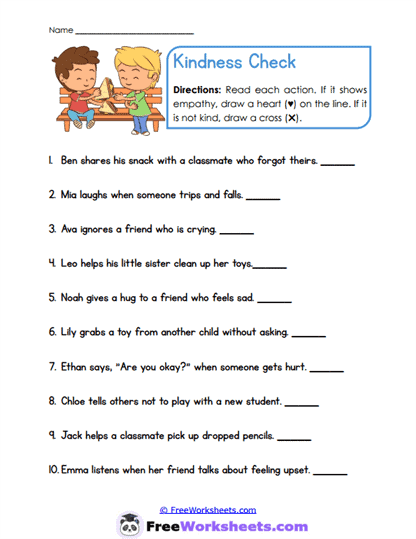
This worksheet helps children recognize whether an everyday action shows empathy or a lack of care. Students read ten short behaviors, such as sharing food, helping someone clean up, listening to an upset friend, laughing when someone falls, or leaving out a new student. They draw a heart beside caring actions and a cross beside unkind ones. The activity gives children clear examples of what empathy can look like through simple choices, words, and responses.
Skills Developed
Students strengthen empathy, behavior awareness, social judgment, and cause-and-effect thinking. They practice noticing whether an action responds to another person’s feelings or ignores, worsens, or dismisses them. The examples also help children understand that empathy may involve sharing, listening, checking on someone, offering comfort, or helping with a problem. These skills support kinder friendships and more thoughtful choices during school, play, and family routines.
Grade & Stage Appropriateness
This worksheet is best suited for early elementary students, especially grades 1 through 3. Children at this stage are learning to recognize emotions in others and connect those emotions with an appropriate response. Younger students may need each sentence read aloud, while older students can explain why every action is caring or unkind. The simple heart-and-cross format makes the lesson approachable for developing readers without removing the need for meaningful thinking.
Connections to Collaborative for Academic, Social and Emotional Learning (CASEL)
This activity connects most strongly with the CASEL areas of social awareness, relationship skills, and responsible decision-making. Students consider how another person may feel and judge whether a behavior supports or harms that person. When I use a page like this, children usually identify the obvious unkind choices quickly, but I spend more time talking about quiet actions such as listening or asking, “Are you okay?” Those moments help students see that empathy does not always require a big gesture; sometimes it simply means noticing and responding with care.
Using This Worksheet
Teachers can use this page during a beginning empathy lesson, morning meeting, friendship unit, or review of classroom expectations. It works well to complete the first few examples together and ask students what feeling the action might create in the other person. Parents and homeschool educators can connect the situations to siblings, playground experiences, and family routines. After finishing, invite the child to choose one caring behavior from the page and practice it that day.