
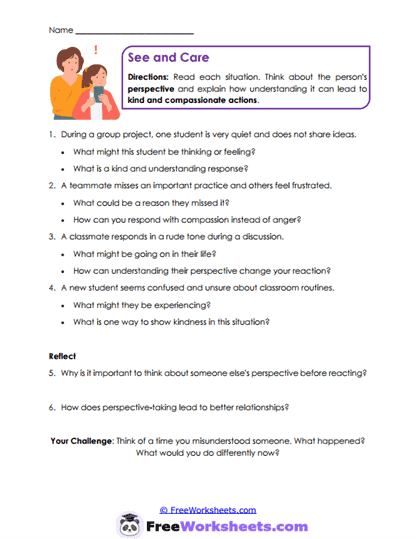
About This Worksheet
This worksheet helps students look beneath another person’s behavior and consider what they may be feeling or experiencing. Children read four situations involving silence during group work, a missed practice, a rude tone, and confusion about classroom routines. They explain possible reasons behind each behavior and describe a kind, understanding response. The activity teaches that compassion often begins by slowing down and becoming curious instead of immediately assuming the worst.
Skills Developed
Students build perspective-taking, empathy, emotional reasoning, and relationship-repair skills. They practice generating more than one possible explanation for a behavior, which helps reduce quick judgments and angry reactions. The reflection questions also ask students why understanding another viewpoint matters and how it can strengthen relationships. These skills support patience, inclusion, and clearer communication when a person’s actions are confusing or frustrating.
Grade & Stage Appropriateness
This worksheet is best suited for upper elementary through middle school students, generally grades 4 through 8. Students at this stage are becoming more capable of understanding that behavior may be influenced by stress, confusion, embarrassment, worry, or experiences they cannot see. Younger learners may need examples of possible perspectives, while older students can explore misunderstandings and the limits of assumptions in greater depth. The activity is especially useful for students who react quickly to tone, silence, missed responsibilities, or behavior they interpret as disrespectful.
Connections to Collaborative for Academic, Social and Emotional Learning (CASEL)
This activity aligns closely with the CASEL areas of social awareness, relationship skills, self-management, and responsible decision-making. Students pause their first reaction, consider another person’s possible experience, and choose a response that invites understanding instead of conflict. In my experience, children often discover that the same behavior can have many explanations once they slow down. I remind them that perspective-taking does not excuse harmful behavior, but it can help us respond more wisely and find out what is actually happening.
Using This Worksheet
Teachers can use this page during lessons about empathy, misunderstandings, inclusion, or respectful classroom discussion. It works well for partner talk because students may suggest different reasonable explanations for the same situation. Parents and homeschool educators can connect the examples to siblings, teammates, family members, or friends whose behavior was misunderstood. Encourage children to replace assumptions with one calm question they could ask before reacting.