
About This Worksheet
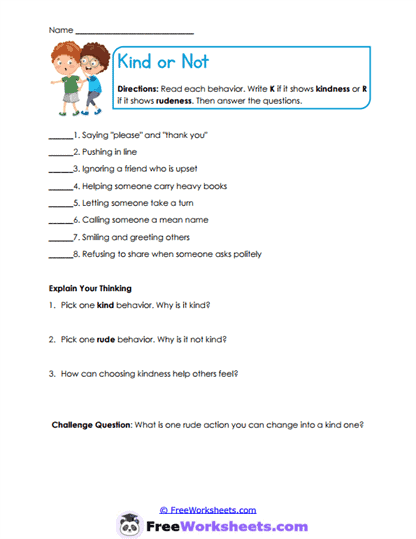
This worksheet helps students tell the difference between kind and rude everyday behaviors. Children read eight actions, including using polite words, pushing in line, helping with books, taking turns, greeting others, ignoring an upset friend, and refusing to share. They label each behavior as kindness or rudeness and then explain one example from each group. The final challenge asks them to change one rude action into a kind one, showing that behavior can be reconsidered and improved.
Skills Developed
Students build social awareness, behavior recognition, empathy, and responsible decision-making. They practice looking beyond whether an action follows a rule and thinking about how it may make another person feel. The explanation questions help children put their reasoning into words rather than simply marking an answer. By changing a rude action into a kind one, students also strengthen flexible thinking and practical problem-solving.
Grade & Stage Appropriateness
This worksheet is best suited for early elementary students, especially grades 1 through 3. The short behaviors and simple labeling task make it accessible to young readers, while the written questions add a useful level of reflection for older children in the range. First-grade students may answer some questions orally, while second- and third-grade students can usually explain their thinking independently. The page is especially appropriate when children are learning classroom manners, friendship habits, and the effect their actions have on others.
Connections to Collaborative for Academic, Social and Emotional Learning (CASEL)
This activity supports the CASEL areas of social awareness, relationship skills, and responsible decision-making. Students consider how common actions affect other people and decide whether those behaviors strengthen or harm a relationship. In my experience, children sometimes know which answer is correct but have never stopped to explain why it matters. I like asking, “What feeling might this action create?” because that moves the lesson from memorizing manners to genuinely understanding kindness.
Using This Worksheet
Teachers can use this page to introduce classroom expectations, review kindness during morning meeting, or support a lesson about friendship choices. It works well to act out a few examples and let students describe how each behavior would feel from the other person’s point of view. Parents and homeschool educators can connect the actions to family routines, playground behavior, and shared spaces. After completing the challenge, encourage the child to practice the rewritten kind action during the same day.