
About This Worksheet
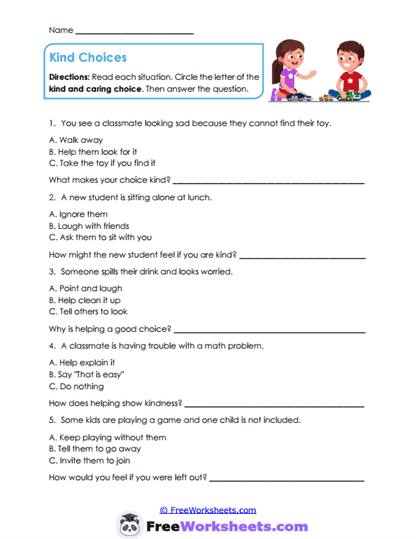
This worksheet helps children choose kind and caring responses in five common school situations. Students consider what to do when a classmate loses a toy, a new student sits alone, someone spills a drink, a peer struggles with math, or a child is left out of a game. They circle the most compassionate choice and then explain how the action may make someone feel or why it is helpful. The activity shows that kindness is not only a feeling but also a choice that can be seen through words and actions.
Skills Developed
Students build empathy, decision-making, perspective-taking, and problem-solving skills. They practice comparing several possible responses and choosing the one that offers help, inclusion, patience, or support. The open-ended questions encourage children to think about the emotional effect of their actions rather than simply selecting the correct letter. These skills can help students become more thoughtful during classroom routines, recess, group work, and friendship situations.
Grade & Stage Appropriateness
This worksheet is best suited for early elementary students, especially grades 1 through 3. Children in this range are learning that their choices can influence whether another person feels supported, ignored, embarrassed, or welcomed. First graders may need the situations read aloud, while second- and third-grade students can usually complete the page and explain their thinking more independently. The short scenarios are familiar enough for young learners but still encourage meaningful reflection about kindness and inclusion.
Connections to Collaborative for Academic, Social and Emotional Learning (CASEL)
This activity supports the CASEL areas of social awareness, responsible decision-making, and relationship skills. Students think about another child’s needs, compare possible actions, and choose the response that is most caring and constructive. In my experience, young children often recognize the kind answer quickly, but the real learning happens when they explain why it helps. I like to ask, “What might change for that person after you make this choice?” because it helps students connect kindness with real emotional impact.
Using This Worksheet
Teachers can complete the first situation together and model how to think through each choice before answering. The page works well during an SEL lesson, partner discussion, small-group activity, or classroom kindness week. Parents and homeschool educators can connect the examples to playground problems, family routines, sports, or neighborhood friendships. Encourage children to explain their answers in their own words, even when their sentence is simple, because the reasoning matters more than using perfect language.