
About This Worksheet
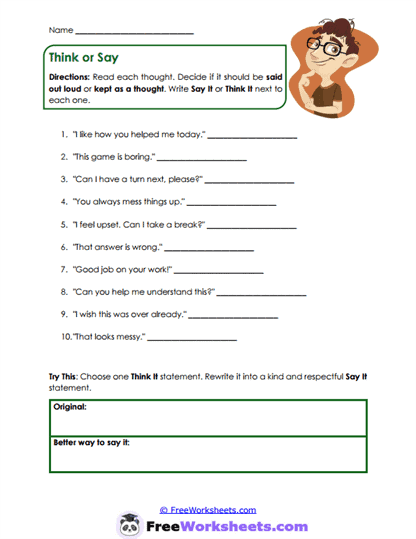
This worksheet teaches students that every thought does not need to be spoken out loud. Children read ten statements and decide whether each one should be shared respectfully or kept as a private thought. The examples include compliments, polite requests, rude judgments, self-advocacy, and frustrated comments. Students then choose one unkind thought and rewrite it as a kinder statement, helping them see that honesty can be expressed without embarrassing or hurting another person.
Skills Developed
Students strengthen impulse control, social awareness, respectful communication, and perspective-taking. They practice thinking about how their words may sound to someone else before speaking. The worksheet also helps children recognize the difference between expressing a need and making a personal attack. These skills can reduce unnecessary conflict and help students participate more thoughtfully in classrooms, friendships, group work, and family conversations.
Grade & Stage Appropriateness
This worksheet is best suited for elementary students in grades 2 through 5. Children at this stage often speak quickly and may not yet understand why a true observation can still be unkind or unnecessary. Younger students may need help discussing the likely effect of each statement, while older students can rewrite several examples and explain their choices. The activity is especially useful for children who struggle with blurting, sarcasm, blunt comments, or speaking before considering another person’s feelings.
Connections to Collaborative for Academic, Social and Emotional Learning (CASEL)
This activity connects strongly with the CASEL areas of self-management, social awareness, relationship skills, and responsible decision-making. Students pause before speaking, consider another person’s feelings, and choose whether their words will help or harm the situation. When I use this kind of lesson, I explain that keeping a thought private is not the same as being dishonest. Sometimes the most responsible choice is to say nothing, and other times we can reshape the thought into words that are both truthful and respectful.
Using This Worksheet
Teachers can use this page during lessons about classroom discussion, kindness, blurting, or respectful peer feedback. It works well to read each statement aloud and ask students how they might feel if someone said it to them. Parents and homeschool educators can connect the examples to sibling conversations, public comments, and moments when a child notices something they do not like. After completing the page, practice a simple pause question such as, “Is it true, kind, helpful, and necessary?”