
About This Worksheet
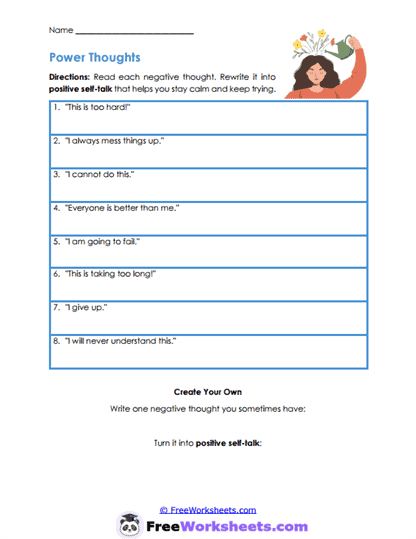
This worksheet helps students turn discouraging thoughts into positive self-talk that supports effort and calm problem-solving. Children rewrite eight common statements, including “I cannot do this,” “I always mess things up,” and “I give up,” so the new thought feels hopeful, realistic, and encouraging. They also identify one negative thought they sometimes have and create a stronger replacement of their own. The activity teaches that positive self-talk does not mean pretending something is easy; it means speaking to yourself in a way that helps you keep trying.
Skills Developed
Students strengthen flexible thinking, perseverance, emotional regulation, confidence, and growth-mindset habits. They practice noticing absolute words such as always, never, and cannot, which can make one difficult moment feel permanent. Rewriting the thoughts helps children focus on effort, learning, asking for help, taking breaks, and trying a different approach. These skills can support students during challenging assignments, mistakes, tests, new activities, and moments when progress feels slow.
Grade & Stage Appropriateness
This worksheet is appropriate for elementary through early middle school students, generally grades 2 through 7. Younger children may need examples of realistic positive thoughts, while older students can create responses that sound personal and believable rather than overly cheerful. The short prompts make the page accessible to developing writers, and the final reflection adds a meaningful personal connection. It is especially helpful for students who become discouraged quickly, fear mistakes, compare themselves with others, or use harsh language about their own abilities.
Connections to Collaborative for Academic, Social and Emotional Learning (CASEL)
This worksheet aligns closely with the CASEL areas of self-awareness, self-management, and responsible decision-making. Students become aware of their inner language, notice how negative thoughts affect emotions and effort, and choose a message that supports a healthier next step. When I use this worksheet, I make sure children understand that positive self-talk should be honest enough to believe. A thought such as “This is hard, but I can try one step and ask for help” is often far more useful than simply saying, “This is easy.”
Using This Worksheet
Teachers can use this page during lessons about persistence, test anxiety, mistakes, confidence, or growth mindset. It works well to compare a harsh thought, an unrealistic positive thought, and a balanced encouraging thought so students can hear the difference. Parents and homeschool educators can connect the activity to homework, sports, music practice, chores, or learning a new skill. Encourage children to choose one replacement thought and place it somewhere visible so they can practice using it during a real challenge.