
About This Worksheet
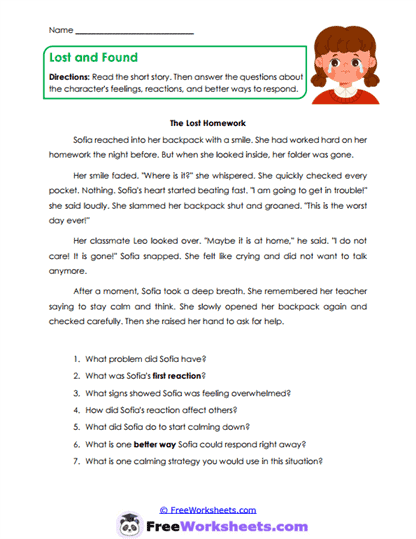
This worksheet uses a short story about Sofia losing her homework to show how worry can quickly grow into an overwhelming reaction. Sofia searches through her backpack, begins to panic, raises her voice, slams the bag, and feels close to tears before remembering that she can slow down and ask for help. Students identify the original problem, her first reaction, the signs that she was overwhelmed, and the choice that helped her begin calming down. The story makes an important point: a stressful problem may still need to be solved, but panic can make it much harder to think clearly.
Skills Developed
Students build reading comprehension, emotional awareness, body-signal recognition, problem-solving, and self-regulation. They practice noticing clues such as a tight chest, fast thoughts, crying, raised voice, and shutting down. The worksheet also helps children compare an impulsive response with a calmer sequence that includes breathing, searching carefully, and asking an adult for support. These skills are useful during lost assignments, forgotten belongings, mistakes, deadlines, and other moments when a child may quickly expect the worst.
Grade & Stage Appropriateness
This worksheet is most appropriate for elementary students in grades 2 through 5. Children in this age range are becoming more responsible for school materials but may still have strong emotional reactions when something important is missing. Younger students may need the story read aloud and support naming signs of overwhelm, while older students can explain how Sofia’s reaction affected her ability to solve the problem. The activity is especially helpful for children who become anxious, tearful, angry, or stuck when they lose something or make a mistake.
Connections to Collaborative for Academic, Social and Emotional Learning (CASEL)
This worksheet supports the CASEL areas of self-awareness, self-management, responsible decision-making, and relationship skills. Sofia recognizes that her reaction is becoming too strong, calms her body, and chooses to ask for help instead of continuing to panic. In my experience, children often believe asking for help means they have failed to handle the problem on their own. I use this story to show that reaching out calmly is often one of the most responsible choices a person can make when emotions are blocking clear thinking.
Using This Worksheet
Teachers can use this story during lessons about anxiety, responsibility, lost work, or coping with everyday problems. It works well to pause before Sofia begins calming down and ask students what she could do next. Parents and homeschool educators can connect the story to misplaced homework, sports equipment, library books, or personal belongings. After the worksheet, help the child create a simple three-step response they can remember: pause, search carefully, and ask for help.