
About This Worksheet
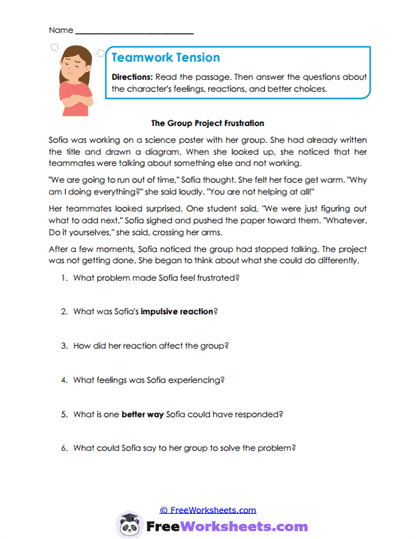
This worksheet uses a short story about Sofia becoming frustrated during a science poster project. She notices that her teammates are talking instead of working and reacts by shouting, insulting them, crossing her arms, and refusing to help. Students examine what caused her frustration, identify her impulsive response, and consider how it affected the whole group. They then suggest a better way Sofia could communicate and explain what she might say to help the team solve the problem.
Skills Developed
Students build reading comprehension, emotional awareness, teamwork, and conflict-resolution skills. They practice separating a reasonable concern from an unhelpful reaction, since Sofia has a real problem but expresses it in a way that stops cooperation. The activity also teaches students to consider how tone, body language, and word choice influence group motivation. These skills are useful whenever children must share responsibility, handle uneven effort, or speak up when a group is falling behind.
Grade & Stage Appropriateness
This worksheet is best suited for upper elementary and early middle school students, especially grades 4 through 7. Students in this range are completing more group assignments and are beginning to notice when responsibilities do not feel equal. Younger learners may need support identifying all of Sofia’s feelings, while older students can discuss leadership, accountability, and respectful ways to redirect peers. The story is particularly appropriate for students who become controlling, angry, or withdrawn when others do not meet their expectations.
Connections to Collaborative for Academic, Social and Emotional Learning (CASEL)
This worksheet aligns closely with the CASEL areas of self-awareness, self-management, relationship skills, social awareness, and responsible decision-making. Sofia must recognize her frustration, manage the urge to attack the group, and communicate in a way that brings everyone back to the shared goal. In my experience, students often agree with Sofia’s concern but quickly notice that her response makes the project even less likely to get finished. I use that moment to show children that speaking up is important, but the way we speak can either invite cooperation or shut it down.
Using This Worksheet
Teachers can use this story before a group project or after students have experienced problems with shared responsibility. It works well to pause before Sofia’s outburst and ask the class to suggest words she could use instead. Parents and homeschool educators can connect the lesson to chores, family projects, sports teams, or shared activities. After the worksheet, have students practice one respectful sentence that names the problem, explains the need, and suggests a fair next step.