
About This Worksheet
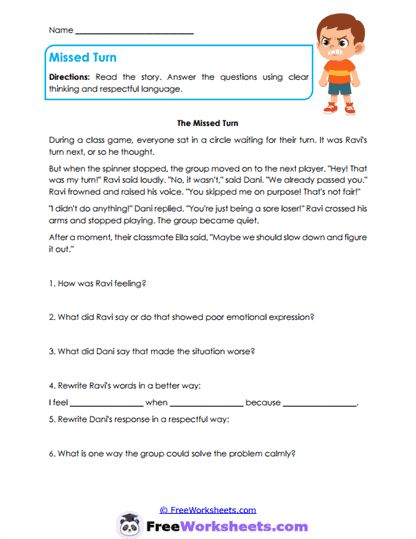
This worksheet tells the story of Ravi, who believes his turn was skipped during a class game and reacts by shouting, crossing his arms, and refusing to continue. Another student responds defensively, which makes the misunderstanding worse. Students identify Ravi’s feelings, examine the actions that increased the conflict, and rewrite both students’ words in a more respectful way. The page also asks them to suggest a calm method the group could use to figure out whose turn should come next.
Skills Developed
Students strengthen perspective-taking, emotional expression, conflict repair, and problem-solving. They learn that feeling left out or treated unfairly can be real even when the situation may have been an accident or misunderstanding. The worksheet helps children practice explaining the problem without accusing someone of acting on purpose and responding without dismissing another person’s feelings. These skills support patience, listening, fairness, and calmer communication during shared activities.
Grade & Stage Appropriateness
This worksheet is best suited for elementary students in grades 2 through 5. Children at this stage are becoming more sensitive to fairness and may react strongly when they believe a rule has not been followed. Younger students may need guidance separating what Ravi knows from what he assumes, while older students can discuss how misunderstandings grow when people become defensive. The activity is especially useful for children who need practice handling missed turns, accidental exclusion, or moments when they feel overlooked.
Connections to Collaborative for Academic, Social and Emotional Learning (CASEL)
This activity supports the CASEL areas of self-awareness, social awareness, relationship skills, self-management, and responsible decision-making. Ravi must recognize his frustration, and the group must listen, consider more than one point of view, and choose a fair next step. In my experience, students often relate strongly to this story because being skipped can feel very personal. I use it to show that a calm question such as “Can we check whose turn it is?” usually works better than assuming someone acted unfairly on purpose.
Using This Worksheet
Teachers can use this page during lessons about fairness, misunderstandings, turn-taking, or respectful disagreement. Role-playing Ravi’s original response and then a calmer version helps students hear how tone changes the direction of a conflict. Parents and homeschool educators can connect the story to board games, sports, lines, and sibling activities. Encourage the child to practice asking for clarification before deciding that someone meant to leave them out.