
About This Worksheet
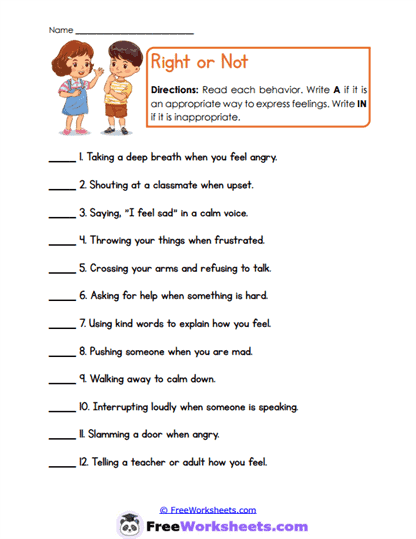
This worksheet asks students to decide whether twelve behaviors are appropriate or inappropriate ways to express feelings. The examples include deep breathing, calmly saying “I feel sad,” asking for help, using kind words, pushing, shouting, slamming a door, and refusing to talk. Students mark each action with an A for appropriate or IN for inappropriate. The activity makes it clear that children are allowed to have strong emotions, while also teaching that some ways of showing those emotions are safer and more helpful than others.
Skills Developed
Students develop emotional regulation, behavior awareness, safety judgment, and responsible decision-making. They practice comparing actions that communicate feelings with actions that may harm people, damage property, or stop a problem from being solved. The worksheet also introduces several healthy choices, including walking away to calm down and telling a trusted adult how they feel. These examples give children a practical set of alternatives they can remember during difficult moments.
Grade & Stage Appropriateness
This worksheet is best suited for early elementary students, particularly grades 1 through 3, though it can also support older children who need direct instruction in emotional behavior. The short statements and simple sorting task make it accessible for developing readers. Younger children may need the examples read aloud, while more advanced students can explain why each action is appropriate or inappropriate. It is especially useful for children learning classroom expectations, personal boundaries, and safe responses to anger or frustration.
Connections to Collaborative for Academic, Social and Emotional Learning (CASEL)
This worksheet supports the CASEL areas of self-management, responsible decision-making, self-awareness, and relationship skills. Students think about how an emotional reaction may affect their body, another person, and the larger situation. When I use this kind of page, I ask children whether the action helps the feeling move safely or sends the problem into someone else’s space. That question usually helps them see why taking a breath or asking for help is appropriate, while pushing or throwing is not.
Using This Worksheet
Teachers can use this activity to introduce classroom calming expectations or review them after students have already learned several coping strategies. After students mark each answer, invite them to replace every inappropriate behavior with one safer choice. Parents and homeschool educators can use the page to create a short family list of actions that are always safe when emotions feel strong. Keep the discussion warm and matter-of-fact so children understand that making an unsafe choice is something to learn from, not a reason to feel ashamed.