
About This Worksheet
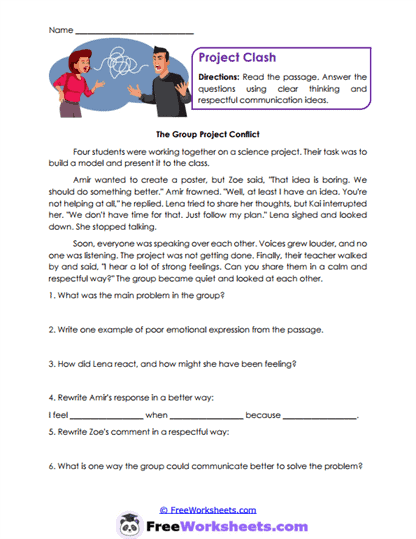
This worksheet uses a short story about four students working on a science project and struggling to communicate respectfully. Amir dismisses Zoe’s idea, Lena becomes upset, Kai interrupts, and soon everyone is talking over one another while the project stops moving forward. Students identify the main problem, find examples of poor emotional expression, and rewrite several statements in a calmer way. The story helps children see how one careless comment can quickly grow into a larger group conflict when no one slows down to listen.
Skills Developed
Students build reading comprehension, perspective-taking, teamwork, emotional awareness, and conflict-resolution skills. They practice noticing how interruptions, insults, silence, raised voices, and crossed arms can affect the whole group. The worksheet also encourages students to use clear feeling language and respectful feedback instead of attacking ideas or people. These skills are especially important during group projects, where success depends on listening, taking turns, and responding to disagreements without shutting others down.
Grade & Stage Appropriateness
This worksheet is best suited for upper elementary and early middle school students, especially grades 4 through 7. Students in this age range are expected to complete more shared assignments and manage differences in ideas with less adult direction. Younger students may need help understanding each character’s feelings, while older students can discuss how tone, body language, and interruptions affect trust and participation. The activity is especially useful before a major group project or after a class has experienced teamwork problems.
Connections to Collaborative for Academic, Social and Emotional Learning (CASEL)
This activity aligns closely with the CASEL areas of relationship skills, social awareness, self-management, and responsible decision-making. Students consider several viewpoints, notice how emotions affect behavior, and practice choosing language that keeps the group moving toward a shared goal. In my experience, children often think the main problem is simply that the group disagrees, but disagreement itself is not the issue. I use this story to show that groups can have different ideas and still work well when members listen, speak respectfully, and make room for everyone.
Using This Worksheet
Teachers can use this page before cooperative learning, science projects, presentations, or any activity that requires shared decision-making. Reading the story aloud with different students taking the character roles can make the communication problems easier to notice. Parents and homeschool educators can connect the lesson to team sports, clubs, sibling projects, or family planning. After completing the page, ask students to create one simple group rule they believe would have prevented the conflict.